
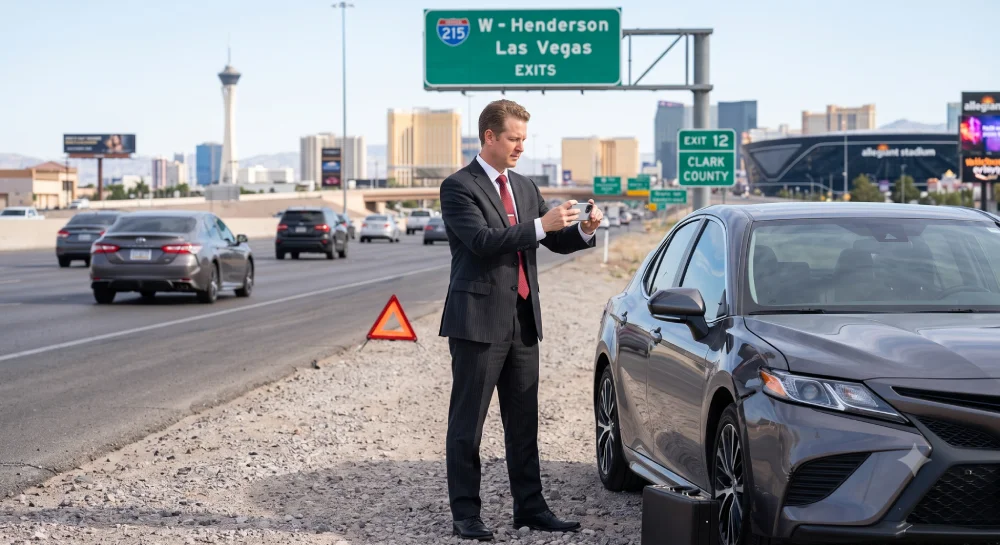
A split second is all it takes for a regular drive down Interstate 15 or the 215 Beltway to turn into a nightmare. One moment you are cruising past the Strip or heading home through Henderson, and the next, you hear the violent crunch of metal and shattering glass. The adrenaline hits immediately, your hands start shaking, and your mind goes completely blank.
Navigating the aftermath of a high-speed freeway crash in Clark County is incredibly stressful. You are dealing with physical pain, vehicle damage, and aggressive insurance adjusters who want to settle your case for pennies. Over my 30 years as a trial lawyer in Las Vegas, I have seen how the choices made on the shoulder of the highway can make or break a personal injury case. You need a clear, no-nonsense game plan to protect your health, your rights, and your financial recovery.
Key Takeaways
- Safety First, Then Clear the Lane: If your vehicle is operational and you are on a dangerous stretch of I-15 or I-215, Nevada law allows you to move to the shoulder to avoid a deadly secondary crash.
- The Police Do Not Always Show Up: For minor property damage without obvious injuries, Las Vegas Metro or Nevada State Police might tell you to exchange information online. You must know how to collect your own evidence.
- Adrenaline Masks Serious Injuries: Soft tissue damage, concussions, and internal bleeding often take hours or days to manifest. Skipping the ER can ruin your physical recovery and your legal claim.
- Nevada Law Mandates Reporting: Under NRS 484E.070, if the police do not investigate a crash causing injury or total property damage over $750, you must file a report with the DMV within 10 days.
What Should I Do in the First 24 Hours After a Freeway Accident?
In the first 24 hours after a crash on I-15 or I-215, you must prioritize your physical health by seeking immediate medical evaluation, collecting comprehensive driver and witness information, capturing extensive photographic evidence of the scene, and consulting an experienced trial lawyer before speaking to any insurance adjuster.
The first day following a major collision sets the foundation for your entire personal injury claim. Insurance companies keep track of timelines. If you wait days to see a doctor or report the incident, their adjusters will claim your injuries were not caused by the freeway accident.
To help you stay focused during a highly chaotic situation, use this exact structural checklist to manage the critical hours following a collision:
1.Move to absolute safety:Immediate.
If the vehicle can be safely driven, move it completely off the active travel lanes of the I-15 or I-215 onto the right shoulder. High-speed secondary collisions on Las Vegas freeways are frequently more dangerous than the initial crash.
2.Call 911 and report the crash:Within 5 minutes.
Tell the dispatcher your exact location (e.g., I-15 Northbound near the Tropicana exit) and clearly state if anyone is feeling pain, dizzy, or visibly hurt. This ensures emergency medical services and the Nevada State Police or Las Vegas Metropolitan Police Department (LVMPD) are dispatched.
3.Document everything at the scene:Within 20 minutes.
Take clear photos and video of all vehicles involved, the surrounding highway markers, skid marks, and the layout of the lanes. Exchange names, phone numbers, driver’s license numbers, and insurance policy details with the other operators.
4.Get medical evaluation immediately:Within 1 to 2 hours.
Go directly to a local emergency room or urgent care facility, such as University Medical Center (UMC) or Sunrise Hospital. Tell the treating physician exactly where your body sustained an impact, even if it only feels like minor stiffness right now.
5.Secure legal protection:Within 24 hours.
Contact my firm to review your case. My team will take over all communication with the insurance companies so you do not accidentally say something that limits your financial recovery.
What Are the Real Legal Consequences of a Nevada Highway Accident?
The financial and legal impact of a crash depends heavily on who is found at fault and the severity of the physical injuries. Nevada operates under a modified comparative fault system (governed by NRS 41.141). This means you can recover compensation as long as you are not more than 50% responsible for the accident, though your final payout will be reduced by your percentage of fault.
The table below breaks down the legal obligations, insurance realities, and statutory timelines every driver face after an interstate collision in Clark County:
| Action / Requirement | What Nevada Law Says | What Happens If You Fail to Comply |
| Stopping at the Scene | NRS 484E.010 mandates that you must stop immediately at any crash scene involving injury or death. | Leaving the scene is an automatic Category B Felony, carrying 2 to 20 years in prison. |
| Exchanging Information | NRS 484E.030 requires you to share your name, address, vehicle registration, and driver’s license. | Can be penalized as a misdemeanor hit-and-run with potential jail time and heavy fines. |
| Filing DMV Form SR-1 | Under NRS 484E.070, you must file a report within 10 days if property damage exceeds $750 and police did not investigate. | The Nevada DMV has the legal authority to suspend your driver’s license for up to one full year. |
| Statute of Limitations | Under NRS 11.190(4)(e), you have a strict deadline to file a personal injury lawsuit. | You lose your right to pursue any financial compensation for your medical bills and pain. |
What Common Mistakes to Avoid After an Interstate Crash?
When drivers are trapped on the side of a busy freeway like the I-215 or I-15, panic often leads to critical errors. Avoid these common traps to safeguard your claim:
- Apologizing to the Other Driver: Saying “I’m so sorry, I didn’t see you merge” might feel like polite conversation, but the insurance company will legally twist it into an admission of fault to deny your injury claim.
- Accepting a Fast Cash Offer: Insurance adjusters frequently call victims within 48 hours of a crash, offering a quick check for $1,000 or $2,000 if they sign a release. Never accept this. Once you sign, you can never ask for more money, even if you later find out you need a $50,000 spinal surgery.
- Relying Solely on a Verbal Agreement: Never agree to “leave the insurance companies out of it” just because the at-fault driver promises to pay for your bumper out of pocket. Once they drive away from the freeway, they can easily block your number, leaving you stuck with the medical bills.
How I Fight for Traffic Accident Victims in Clark County
When you are hurt in an accident, the insurance company’s goal is to protect their corporate profits. My goal is to protect you. Over my three decades practicing law in Southern Nevada, my firm has developed an aggressive method for holding negligent drivers accountable.
Here is exactly how I build a winning personal injury case for my clients:
1. Reconstructing the Interstate Speed and Lane Positions
Accidents on the I-15 and I-215 usually involve high speeds, tailgating, and sudden lane changes. I regularly work with independent accident reconstruction experts. We analyze vehicle black box data, tire marks, and debris fields to prove exactly how fast the at-fault driver was moving and which lane they illegally entered.
2. Pulling Local Camera Footage
The Nevada Department of Transportation (NDOT) maintains traffic cameras across the major freeway systems in Las Vegas. While these cameras do not always record, my firm moves immediately to subpoena any available highway footage, nearby casino exterior video, and commercial dashcam reels before the data is erased.
3. Calculating the True Cost of Your Long-Term Recovery
I do not just look at your current emergency room bill. I collaborate with your medical providers to calculate the cost of future physical therapy, necessary surgeries, lost wages from missing work, and the physical pain and suffering you have been forced to endure.
Frequently Asked Questions
Do I have to call the police for a minor fender bender on I-15?
Yes, if the accident causes any physical injuries or if the total property damage looks to be $750 or more, Nevada law requires you to immediately report the accident to law enforcement. If they choose not to respond to the scene, you must file an SR-1 report.
Who pays for my medical treatment after a car accident in Las Vegas?
Nevada is a traditional fault state. The driver who caused the freeway accident is ultimately responsible for your medical bills. However, their insurance company will not pay your doctors in real-time; they pay out in a lump sum settlement at the end of your case. In the meantime, we use your health insurance, Medical Payments (MedPay) coverage, or medical liens to ensure you get care.
What happens if the driver who hit me on the I-215 does not have insurance?
Despite strict state laws, thousands of motorists drive through Las Vegas without insurance. If you are hit by an uninsured driver, we can file a claim under your own policy’s Uninsured/Underinsured Motorist (UM/UIM) coverage. This protection ensures your own insurance steps in to cover your losses.
How many car accidents happen in Las Vegas every day?
The traffic density on our freeways is incredibly high. According to data provided by the Nevada Office of Traffic Safety, the metro area sees more than 20,000 crashes annually, which averages out to roughly 56 traffic collisions occurring every single day in Clark County.
Can I still get compensation if I was partially at fault for the crash?
Yes. Under Nevada’s modified comparative fault rule, you can recover damages as long as your share of the blame is 50% or less. For instance, if a jury determines you were 10% at fault because you were traveling slightly over the speed limit, your final financial recovery will be reduced by exactly 10%.
Should I give a recorded statement to the other driver’s insurance company?
Never give a recorded statement without speaking to a personal injury attorney first. Insurance adjusters are trained to ask misleading questions designed to make you admit to fault or downplay the severity of your physical pain.
How long do I have to file a lawsuit after a car accident in Nevada?
Nevada has a strict two-year statute of limitations for personal injury lawsuits. If you do not file your official lawsuit within exactly two years of the date of the freeway accident, you lose your legal right to pursue compensation forever.
Get an Experienced Las Vegas Trial Attorney in Your Corner
When you are recovering from a major accident on the I-15 or I-215, you should be focusing on healing—not fighting with insurance corporations. The legal system moves fast, and big insurance companies have teams of defense lawyers working right away to limit your payout.
I bring over 30 years of local courtroom experience to every case, fighting for my clients with absolute integrity and deep compassion. My firm handles personal injury cases on a contingency fee basis, meaning you pay nothing out of pocket, and we only get paid if we win your case.