
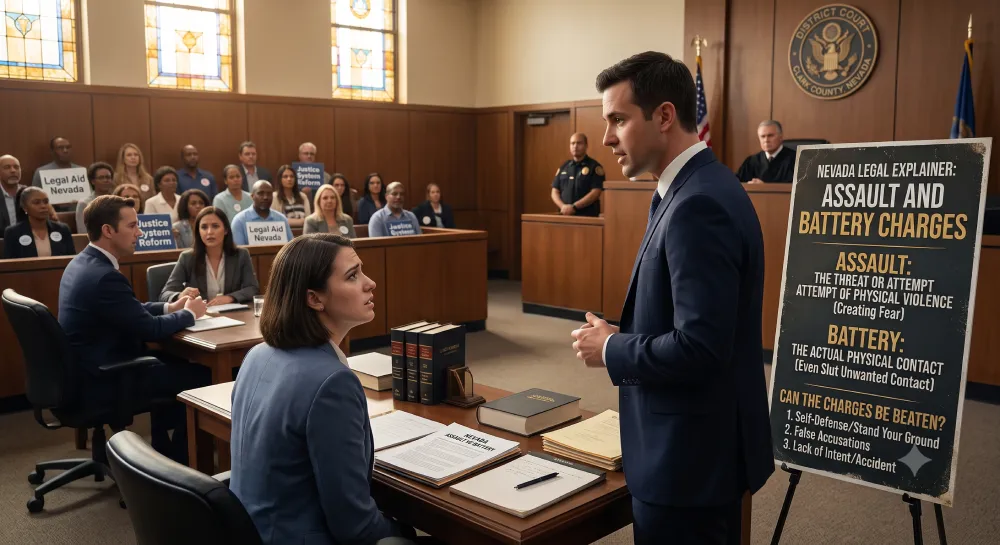
A bar fight. A road rage argument that got out of hand. A shove at a concert on Fremont Street. Whatever brought you here — the difference between these two charges matters enormously, and what happens next depends entirely on who is fighting for you.
Here is a scenario that plays out in Las Vegas hundreds of times every single year. Two people get into it at a bar near the Strip. Maybe words were exchanged first. Maybe somebody threw a drink. Maybe it started in the parking lot after a Raiders game. One person gets arrested. Often both do. And by morning, you are sitting there staring at a charge sheet wondering exactly what you did wrong — and what it is actually going to cost you.
Most people use the phrase “assault and battery” like it is one thing. It is not. In Nevada, they are two separate crimes defined under two separate statutes, and the difference between them can be the difference between a misdemeanor that fades from your record and a felony that follows you for the rest of your life.
Here is everything you need to know — spelled out clearly, without legal jargon — about how assault and battery work in Nevada, what the penalties look like, how self-defense actually plays out in court, and the real answer to the question everyone asks: Can these charges actually be beaten?
For over 30 years, The Law Offices of Michael I. Gowdey, LTD has been answering that question for clients in Las Vegas, Henderson, North Las Vegas, and throughout Nevada. The short answer is yes — with the right attorney, the right strategy, and the right facts. The longer answer is on this page.
★ Read This First — Key Takeaways
What Every Person Facing Assault or Battery Charges in Nevada Needs to Know
- Assault is threatening or attempting to harm someone — no physical contact required. Battery is the actual unwanted physical contact. You can be charged with both at once.
- In 2024, Clark County recorded 9,973 violent crimes total — a 5.57% drop from 2023, but aggravated assault still makes up the largest single category.
- The Las Vegas Valley had a 7.3% decline in violent crime in 2024 — beating the national average of 4.5% — but assault and battery charges remain among the most frequently prosecuted crimes in the Eighth Judicial District Court.
- A simple bar fight or shove can escalate from a misdemeanor to a Category B felony the moment a weapon gets involved or someone suffers “substantial bodily harm.”
- Nevada is a Stand Your Ground state — you have no duty to retreat before using force in self-defense, and this has been Nevada law since the 1870s under NRS 200.120.
- Only the prosecutor — not the victim — can drop assault or battery charges in Nevada. If the alleged victim “refuses to press charges,” the state can still prosecute using police reports, video, and witness testimony.
- Battery on a protected person (police officer, healthcare worker, school employee, transit worker) automatically elevates the charge — even when there is no serious injury.
- An experienced assault defense attorney can challenge intent, contest the victim’s credibility, raise self-defense, and pursue charge reduction — but timing matters enormously.
9,973
Total violent crimes in Clark County in 2024 (NV Crime Stats)
-7.3%
Las Vegas Valley violent crime decline in 2024 — better than national average
1,188
Violent crimes reported in North Las Vegas in 2024
2–15 Yrs
State prison for battery with deadly weapon + serious injury (NRS 200.481)
What Is the Legal Definition of Assault vs. Battery in Nevada?
This is where most people trip up. They think “assault” means hitting someone. It does not — not in Nevada. And they think “battery” requires serious injury. Also wrong. Let’s clear this up for good.
Assault
NRS 200.471
An unlawful attempt or threat to commit physical harm on another person — without physical contact. The key word is “apprehension.” If the other person reasonably believed they were about to be harmed, that is enough for an assault charge.
- No touching required
- Victim must have reasonably feared immediate harm
- Intent to threaten or attempt harm must exist
- Example: raising a fist, pointing a weapon, lunging toward someone
Battery
NRS 200.481
Any willful and unlawful use of force or violence upon another person. Physical contact is required. The contact does not have to cause injury — a shove, slap, or spit can all qualify as battery under Nevada law.
- Physical contact must occur
- Contact must be intentional — not accidental
- No visible injury is required
- Example: punching, shoving, throwing an object that hits someone
The simplest way to remember it: assault is the threat, battery is the act. You can commit assault without ever touching the other person. And the moment contact happens — even a slap, even a shove — it crosses into battery territory.
In practice, a lot of cases involve both. Someone raises a fist and threatens a person (assault), then actually throws the punch (battery). The prosecutor can charge both at once, which is why you often see the phrase “assault and battery” in the same breath — even though Nevada law treats them as distinct offenses.
Something Most People Do Not Know
Nevada courts have consistently held that “mere menace” is not enough to constitute assault. Under the Nevada Supreme Court’s ruling in Wilkerson v. State (1971), there must be an actual effort to carry the threatening intention into execution — not just words or a look. An experienced attorney knows exactly where that line is and how to argue around it.
Real-World Scenarios — What Gets Charged as What in Las Vegas
Bar Fight on the Strip
Argument escalates. One person raises a bottle and threatens the other. No contact made before security intervenes.
Likely: Simple Assault (misdemeanor)
Parking Lot Shove
Argument after a fender-bender. One driver shoves the other. No weapon. No serious injury.
Likely: Simple Battery (misdemeanor)
Road Rage with a Weapon
Driver pulls over, brandishes a tire iron, threatens another driver with it.
Likely: Assault with Deadly Weapon (Category B Felony)
Bar Fight — Serious Injury
Punch thrown. Victim hits their head on the floor. Broken jaw, loss of consciousness.
Likely: Battery with Substantial Bodily Harm (Category C Felony)
Pushing a Security Guard
Shove during a heated argument. Security guard is on duty at a casino.
Likely: Battery on Protected Person (Gross Misdemeanor at minimum)
Concert Altercation
Mutual shoving match. Both parties make contact. Both claim the other started it.
May result in charges for both; self-defense/mutual combat arguments possible
What Are the Penalties for Assault and Battery in Nevada?
This is where the stakes become very real, very fast. The gap between a simple misdemeanor assault and a felony battery with a deadly weapon is enormous — we are talking about the difference between a fine and community service on one end, and 2 to 15 years in state prison on the other.
Here is the full breakdown under NRS 200.471 and NRS 200.481:
| Charge | Classification | Jail / Prison | Fine |
|---|---|---|---|
| Simple Assault (no weapon, no protected victim) | Misdemeanor | Up to 6 months jail | Up to $1,000 |
| Assault on Protected Person (officer, healthcare worker, etc.) | Gross Misdemeanor | Up to 364 days jail | Up to $2,000 |
| Assault with a Deadly Weapon | Category B Felony | 1–6 years prison | Up to $5,000 |
| Simple Battery (no weapon, no substantial harm) | Misdemeanor | Up to 6 months jail | Up to $1,000 |
| Battery on Protected Person (no strangulation, no substantial harm) | Gross Misdemeanor | Up to 364 days jail | Up to $2,000 |
| Battery with Substantial Bodily Harm | Category C Felony | 1–5 years prison | Up to $10,000 |
| Battery by Strangulation | Category C Felony | 1–5 years prison | Up to $10,000 |
| Battery with Deadly Weapon (no substantial harm) | Category B Felony | 2–10 years prison | Up to $10,000 |
| Battery with Deadly Weapon + Strangulation or Substantial Harm | Category B Felony | 2–15 years prison | Up to $10,000 |
The “****Protected Person****”** Escalation — Few People Know This**
If you get into a physical altercation with any of the following people while they are performing their duties, the charge automatically jumps — even if there is no injury and no weapon: police officers, sheriff’s deputies, healthcare providers, school employees, taxicab drivers, transit operators, utility workers, and sports officials. You do not need to have known their occupation at the time of the incident, but the prosecutor will argue you should have known. Casino security personnel often fall into protected categories as well. This is one of the most common escalation traps in Las Vegas assault cases.
Beyond jail time and fines, a conviction — even a misdemeanor — carries consequences that do not appear on the penalty chart. A conviction for battery can affect your ability to own firearms. It can appear on background checks for jobs, housing, and professional licensing. It can complicate immigration status for non-citizens. And if the case involves domestic violence, the consequences are even more severe and far-reaching.
Does Self-Defense Work as a Legal Defense in Nevada?
Yes — and Nevada has some of the strongest self-defense laws in the entire country. This is not a loophole. It is a deeply embedded legal principle that has been part of Nevada law since the 1870s.
Nevada is both a Stand Your Ground state and a Castle Doctrine state under NRS 200.120. Here is what that means in plain language.
Stand Your Ground — No Duty to Retreat
In many states, a person being threatened is expected to try to get away from the situation before using force. Nevada does not require that. Nevada’s no-duty-to-retreat standard has been law since the 1870s. If you are being threatened and you have a right to be where you are, you are allowed to stand your ground and defend yourself — as long as three conditions are met:
- You were not the original aggressor — you did not start the confrontation
- You were legally present at the location where force was used
- You were not engaged in criminal activity at the time
That last point is important. If you were in the middle of committing a crime when the altercation began, the Stand Your Ground protections generally do not apply to you.
Castle Doctrine — Your Home and Your Vehicle
Under NRS 200.120, if someone unlawfully and forcibly enters your occupied home or vehicle, Nevada law presumes you have a reasonable fear of imminent danger. You are not required to retreat, and the use of force — including deadly force — may be legally justified. The Castle Doctrine applies to occupied homes and vehicles. An unoccupied home or car does not trigger the same presumption.
How Self-Defense Plays Out in Assault and Battery Cases
Self-defense is what lawyers call an “affirmative defense.” You are not arguing that the event did not happen — you are arguing that what you did was legally justified. That is a different kind of case to build, and it requires a different kind of strategy.
The prosecution will try to paint you as the aggressor. Your attorney’s job is to present the evidence — surveillance footage, witness statements, medical records showing prior injury or threatening behavior — that shows you responded reasonably to an actual threat. Nevada courts have recognized that self-defense is valid even when the defendant’s fear of harm was reasonable but not based on actual immediate danger, as established in Culverson v. State (1990).
One Critical Caveat on Self-Defense
The force you use must be proportionate to the threat you faced. Using a weapon against someone who shoved you is very likely excessive force — and excessive force defeats a self-defense claim. The Nevada Supreme Court’s 2025 ruling in Becerril v. State reinforced that if a defendant’s actions immediately after using force demonstrate anger or a desire to punish the victim rather than defend themselves, the defense may fail. Proportionality and reasonable belief are the two pillars of every successful self-defense argument.
What Is Aggravated Assault and How Is It Different?
People hear the word “aggravated” and assume it just means a more serious version of regular assault. That is roughly right, but the specific factors that turn a simple assault into an aggravated one make an enormous difference in how a case is charged and defended.
In Nevada, the term “aggravated assault” most commonly refers to an assault that involves one or more of the following circumstances:
Use of a Deadly Weapon
This is the most common aggravating factor in Las Vegas assault cases. A “deadly weapon” in Nevada is broadly defined — it is not just a firearm or a knife. Courts have found that bottles, bats, vehicles, and other objects can qualify as deadly weapons depending on how they were used. The moment a weapon enters the picture, the charge escalates to a Category B felony carrying 1 to 6 years in prison and fines up to $5,000.
But here is something worth understanding: what counts as a “deadly weapon” is actually one of the most litigated questions in Nevada assault cases. In Rodriguez v. State (2017), the Nevada Supreme Court clarified that courts have discretion in applying either the “functional” or the “inherently dangerous” definition of deadly weapon. An experienced attorney knows how to challenge whether a specific object meets that legal threshold.
Victim’s Protected Status
As discussed above, assaulting a police officer, healthcare worker, school employee, or other protected class member automatically elevates the charge. Assault on a protected person with a deadly weapon is also a Category B felony.
The Defendant’s Status at the Time
If you are on parole, probation, or in custody — and you commit an assault without a deadly weapon — it escalates to a Category D felony carrying 1 to 4 years in prison. The same basic act carries a completely different consequence depending on whether you were under court supervision at the time.
Substantial Bodily Harm
When a battery causes “substantial bodily harm” — meaning a protracted loss of consciousness, broken bones, severe lacerations, permanent disfigurement, or similar serious injuries — the charge escalates to a Category C felony even without any weapon being involved.
The Strangulation Enhancement — Especially Important
One of the most serious and often misunderstood escalators in Nevada battery law is strangulation. Under NRS 200.481, battery by strangulation — even without a weapon, even without visible injury — is automatically a Category C felony carrying 1 to 5 years in prison. If the strangulation also causes substantial bodily harm and involved a weapon, that becomes a Category B felony with up to 15 years in prison. This provision is particularly relevant in domestic violence cases.
Can Assault Charges Be Dropped If the Other Person Refuses to Cooperate?
This is one of the most common questions attorneys hear after an assault or battery arrest — and the answer surprises almost everyone who asks it.
The short answer: No — the victim does not control whether charges are dropped in Nevada.
Here is how it actually works. In Nevada, criminal charges are filed by the State — specifically, by the Clark County District Attorney’s office or by the city attorney depending on the jurisdiction. The alleged victim is a witness in the state’s case. They are not the plaintiff. They do not own the charges. They cannot make the charges disappear by saying they do not want to press charges anymore.
Only the prosecutor has the authority to dismiss a criminal charge in Nevada. Even if the alleged victim contacts the DA’s office and says they do not want the case to proceed, the state can still prosecute — and often does — based on:
- Police reports and the arresting officer’s observations
- Surveillance video from bars, casinos, streets, or doorbell cameras
- Witness statements from bystanders who saw what happened
- Medical records showing injuries
- 911 call recordings
- Prior history between the parties
This is especially true in cases that started in high-surveillance areas — which describes most of Las Vegas. The Strip, Fremont Street, casino floors, parking garages, and even most residential areas in the valley are covered by cameras. A victim choosing not to cooperate does not erase what was captured on video or stated to police at the scene.
What a Victim’s Non-Cooperation Actually Does
While it does not automatically end the case, a victim who refuses to cooperate can significantly weaken the prosecution’s hand — especially in cases where there is minimal physical evidence beyond their testimony. An experienced attorney knows how to use this to negotiate for reduced charges or dismissal, but it requires understanding the specific facts of your case and the tendencies of the prosecutor handling it in your jurisdiction.
That said, a victim who actively recants their statement — rather than simply declining to cooperate — creates a different set of issues. If the recantation is credible and unsolicited, it can be a powerful tool for the defense. If the prosecution believes the recantation was influenced or coerced, they may choose to proceed anyway and present the original statements as evidence.
What Are the Real Legal Defenses Available in Nevada Assault and Battery Cases?
Yes, these charges can be beaten. Here is how experienced defense attorneys actually approach these cases — and why every single defense depends on the specific facts of your situation.
Self-Defense or Defense of Others
Covered in detail above. This is the most commonly raised defense in assault and battery cases in Las Vegas. If the evidence supports it, Stand Your Ground is a powerful tool — particularly in bar fight or road rage situations where the question of “who started it” is genuinely contested.
Lack of Intent
Both assault and battery require intentional acts. If the contact was accidental — bumping into someone in a crowded bar, for example — there is no battery. The prosecutor must prove that the act was willful. If the evidence does not clearly show intent, this is a genuine defense.
Challenging the Victim’s Credibility
Did the alleged victim have a reason to lie? Were they intoxicated at the time? Do their statements to police contradict the physical evidence or the surveillance video? Do they have a prior relationship with the defendant that colors their account? These are exactly the questions a skilled defense attorney investigates before the case ever goes to trial.
Insufficient Evidence
The prosecution must prove every element of the charge beyond a reasonable doubt. If the only evidence is the alleged victim’s word and there is no corroborating video, no independent witnesses, and no physical evidence of injury, that is a case worth fighting aggressively.
Mutual Combat / Consent
In situations where both parties voluntarily agreed to fight — a genuine mutual altercation where both sides were willing participants — Nevada courts have recognized consent as a potential defense in limited circumstances. This does not apply to cases where one party clearly overpowered the other or where weapons were used.
Unlawful Stop or Improper Police Procedure
If the evidence against you was gathered through an unlawful police stop or an improper arrest, a motion to suppress that evidence can be filed. Evidence that is suppressed cannot be used against you at trial. If the suppressed evidence was central to the prosecution’s case, charges may be reduced or dismissed entirely.
MG
Attorney Michael I. Gowdey — 30+ Years Defending Assault &** Battery Cases in Nevada**
Assault and battery charges are among the most fact-intensive cases in criminal defense. The difference between a conviction and a dismissal often comes down to a single piece of surveillance video, one witness’s account, or a question about who threw the first punch. For over three decades, Attorney Michael I. Gowdey has been dissecting these cases in Las Vegas, Henderson, North Las Vegas, and throughout Nevada — challenging the prosecution’s evidence, asserting self-defense where the facts support it, and fighting for outcomes that protect his clients’ futures.
Multiple awards. Deep courtroom experience in the Eighth Judicial District. A genuine belief that justice requires more than just showing up — it requires fighting with strategy, empathy, and heart.
Schedule a Free Consultation Today →
What Does the Assault Landscape Look Like in Las Vegas, Henderson, and North Las Vegas Right Now?
Understanding the enforcement environment you are walking into matters when you are facing these charges. Clark County is not just any jurisdiction.
According to 2024 crime data, the Las Vegas Valley outperformed the national trend on violent crime reduction — down 7.3% across LVMPD, Henderson, North Las Vegas, and Boulder City combined, compared to a 4.5% national average decline. Clark County as a whole recorded 9,973 violent crimes in 2024, down 5.57% from 2023. North Las Vegas reported 1,188 violent crimes — including 714 aggravated assaults — in 2024 alone.
Still, Clark County’s violent crime rate of 4,467.4 per 100,000 residents sits above the Nevada state average of 4,132.5 — meaning the Las Vegas Valley remains one of the more active criminal court jurisdictions in the state. Aggravated assault consistently makes up the largest single category within violent crime statistics for both LVMPD and Henderson Police Department.
What this means for someone charged with assault or battery here is simple: prosecutors in Clark County handle these cases routinely and aggressively. There is real institutional experience on their side. You need someone with equal or greater experience on yours.
The Eighth Judicial District Court — which handles felony cases in Clark County — processes thousands of violent crime cases each year. Knowing the tendencies of the judges, the negotiating patterns of the DA’s office, and the local evidentiary standards is not something you can learn from a book. It comes from decades of actual courtroom experience in that building, with those prosecutors, in front of those judges.
That is what The Law Offices of Michael I. Gowdey, LTD provides. And beyond criminal defense, if your assault case has a civil component — say, a personal injury claim from the alleged victim — the firm’s personal injury practice means you have comprehensive coverage under one roof.
Do Not Wait on This
Surveillance footage gets overwritten. Witnesses move or change their stories. The earlier an experienced attorney gets involved, the more options exist for preserving evidence, challenging the prosecution’s case, and pursuing the best possible outcome. Contact The Law Offices of Michael I. Gowdey, LTD today.
Top 10 Questions People Ask Assault and Battery Lawyers in Nevada
- Can I be charged with assault in Nevada even if I never touched the other person?
Yes. Under NRS 200.471, assault does not require physical contact. If you intentionally threatened someone or made an attempt to cause them physical harm — and they reasonably feared immediate bodily injury — that is assault under Nevada law. Raising a fist, lunging toward someone, or pointing a weapon are all examples of assault without physical contact. The key factor is whether the alleged victim’s fear was reasonable under the circumstances.
2. What is the difference between simple battery and aggravated battery in Nevada?
Simple battery under NRS 200.481 is a misdemeanor — a slap, push, or punch with no serious injury and no weapon. Aggravated battery occurs when a weapon is used, when the victim suffers substantial bodily harm, when strangulation is involved, or when the victim is a protected person such as a police officer, healthcare worker, or school employee. These aggravating factors can elevate the charge from a misdemeanor to a Category B or Category C felony, with prison terms ranging from 1 to 15 years depending on the specifics.
3. Can assault or battery charges be reduced to a lesser offense in Nevada?
Yes, in many cases. Reduction to a lesser charge — or even complete dismissal — is one of the most important things an experienced defense attorney pursues. Depending on the evidence, your prior record, and the specific facts of the case, a felony battery charge might be negotiated down to misdemeanor battery, or even to a civil compromise in limited circumstances. First-time offenders with no prior record are generally in a better position to negotiate, but even repeat charges can be challenged on evidentiary grounds.
4. What happens if I get into a bar fight on the Las Vegas Strip and both people are arrested?
Both parties can be charged, and prosecutors often do exactly that when the evidence shows mutual participation. That said, the person who threw the first punch, who escalated the violence, or who used a weapon will typically face more serious charges. Mutual combat situations are complex because they involve competing claims of self-defense and provocation. Surveillance video — which is ubiquitous on the Strip — often becomes the central piece of evidence in these cases. Getting an attorney involved immediately after arrest is essential.
5. Is Nevada a Stand Your Ground state, and how does it affect my assault defense?
Yes. Nevada has been a Stand Your Ground state since the 1870s under NRS 200.120. You have no legal duty to retreat before using force in self-defense, as long as you were not the initial aggressor, were legally present at the location, and were not engaged in criminal activity. In practice, this means a self-defense argument in Nevada does not require you to have tried to walk away first — only that your use of force was reasonable and proportionate to the threat you faced.
6. Can I go to jail for assault or battery in Nevada even if it is a first offense?
Technically yes, though first-time misdemeanor offenders often receive alternatives to jail time — probation, community service, anger management classes, or fines — especially with good legal representation. The risk of actual jail time increases significantly when any aggravating factor is present: a weapon, a protected victim, substantial injury, or prior criminal history. A felony assault or battery conviction on a first offense absolutely carries the possibility of prison time regardless of the absence of prior record.
7. Can an assault or battery conviction be sealed from my Nevada criminal record?
Yes, for misdemeanor convictions, a Nevada record seal is generally available after a statutory waiting period following the close of the case. For category C felony battery, the waiting period is longer. If the charges are completely dismissed, you can petition for an immediate record seal. A sealed record cannot be seen by most employers, landlords, or licensing agencies. This is one of the most valuable outcomes your attorney can pursue — even if complete dismissal is not achievable, a reduction that results in a sealable conviction is often a significant win.
8. What are the immigration consequences of an assault or battery conviction in Nevada?
Any violent crime conviction — including assault or battery — can be used as the basis for deportation or denial of immigration benefits for non-citizens. This applies to misdemeanor convictions as well as felonies. Green card holders, visa holders, and people in DACA status are all at risk. The immigration consequences of a criminal conviction are a critical part of the defense strategy for any non-citizen client, and they should be discussed with an attorney who understands both areas of law before any plea is entered.
9. What if I was defending someone else — a friend, a partner, a stranger — when the altercation happened?
Defense of others is a legitimate legal defense under Nevada law. The same standards that apply to self-defense apply to defense of a third party: you must have reasonably believed the other person was facing imminent harm, you must not have been the aggressor, and the force used must have been proportionate to the threat. Courts apply a reasonable person standard — would a reasonable person in your position have believed that the person you were defending was in danger? Evidence of the victim’s threatening behavior or prior acts of violence toward the person you defended can support this claim significantly.
10. How long do I have to deal with an assault or battery charge before my case is resolved?
Misdemeanor assault and battery cases in Las Vegas typically move through the court system within a few months to around a year, depending on the court’s calendar and whether the case goes to trial. Felony cases take longer — often 12 to 18 months or more — especially when suppression motions, expert witnesses, or extensive discovery are involved. During this time, you may have conditions of release, protective orders, or other restrictions. Having an attorney who actively manages the timeline and pushes for early resolution when the evidence supports it can meaningfully shorten this period.
The Law Offices of Michael I. Gowdey, LTD
Justice with Integrity | Representation with Heart
Serving Las Vegas · Henderson · North Las Vegas · All of Nevada — gowdeylaw.com/
This page is for general informational purposes only and does not constitute legal advice. Reading this page does not create an attorney-client relationship. Every case is unique — contact our office directly to discuss the specifics of your situation.