
Let me walk you through both paths clearly and honestly.
What Is an Uncontested Divorce in Nevada?
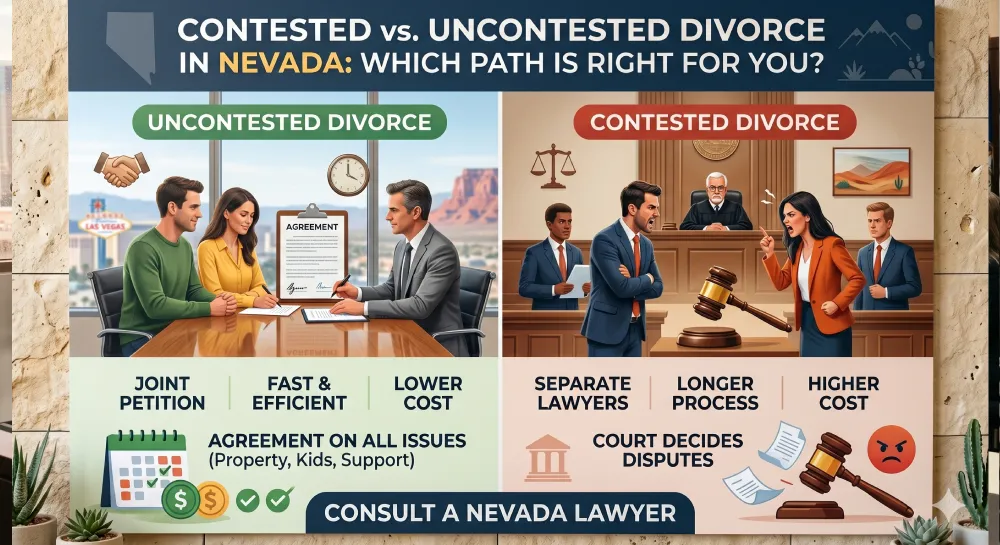
An uncontested divorce is one in which both spouses agree on all material issues before the case is finalized. This includes division of marital property and debts, whether either spouse will receive alimony (and if so, how much and for how long), if the couple has children, custody arrangements and parenting time, and child support.
An uncontested divorce does not necessarily mean there is no conflict or hurt feelings — it means the legal issues have been resolved through agreement. The process can happen in two ways:
- Joint Petition: Both spouses file together at the outset, submitting a completed settlement agreement with the initial filing. This is the fastest possible route.
- Complaint and Agreement: One spouse files, the other is served and responds, and the couple works out an agreement during the case. This is still considered “uncontested” if it ultimately resolves without a trial.
Nevada courts — including the Clark County Eighth Judicial District Family Court — facilitate uncontested divorces efficiently. For a comprehensive overview of both processes, see our dedicated page on contested vs. uncontested divorce in Nevada.
The Benefits of an Uncontested Divorce
Choosing the uncontested path — when it’s genuinely appropriate — offers real advantages:
- Speed: A simple uncontested Nevada divorce can be finalized in 3 to 10 weeks. A contested divorce can take 12 to 24 months or more.
- Cost: Uncontested divorces cost a fraction of contested ones. Court fees in Clark County are under $500 to file. Attorney fees for an uncontested divorce, when agreements are already in place, are dramatically lower than for a contested trial.
- Privacy: Contested divorces generate extensive court filings that become public records. An uncontested divorce keeps the details of your assets, finances, and personal circumstances out of the public eye.
- Control: When you negotiate an agreement, you control the outcome. A judge who hears a contested case decides for you — and neither party may be happy with the result.
- Lower emotional cost: Adversarial litigation is stressful, time-consuming, and emotionally draining. Particularly for parents who must continue co-parenting after divorce, the uncontested path reduces lasting damage to the co-parenting relationship.
What Is a Contested Divorce in Nevada?
A contested divorce is one in which the parties cannot agree on one or more material issues and require a judge to decide. Contested issues commonly include:
- Who keeps the marital home — or whether it must be sold and proceeds divided
- How retirement accounts accumulated during the marriage are divided
- Whether one spouse is entitled to alimony and for how long
- How custody of minor children is arranged — legal custody, physical custody, and parenting time
- Child support amounts
- Division of business interests
- Which spouse is responsible for specific debts
It’s worth understanding that a divorce can start contested and become uncontested — and vice versa. Many couples reach agreement during mediation or negotiation and avoid trial entirely. In Clark County, Family Court actively encourages mediation as a path to resolution.
The Contested Divorce Process in Clark County
If your divorce is or becomes contested, here’s what the process looks like in the Las Vegas Valley:
Phase 1: Filing and Service
One spouse files a Complaint for Divorce in Clark County District Court. The other spouse is served with the complaint and has 21 days to respond. The response admits or disputes the allegations and sets out the responding party’s positions.
Phase 2: Temporary Orders
Either party can request temporary orders from the court on an emergency or standard basis. Temporary orders address urgent issues while the case is pending: who lives in the marital home, temporary custody and parenting time, temporary support, and restraining orders on asset dissipation. These hearings are typically scheduled within 30 to 60 days of filing.
Phase 3: Discovery
Both parties exchange financial and other relevant information through formal discovery — interrogatories, requests for production of documents, depositions, and subpoenas to third parties like banks and employers. This phase can take 3 to 6 months in a moderately complex case and significantly longer when financial matters are complex or one party is uncooperative.
Phase 4: Expert Evaluation (if needed)
Contested cases often require expert witnesses. Business valuation experts analyze the value of closely held companies. Real estate appraisers establish property values. Forensic accountants trace the movement of financial assets. Custody evaluators assess parenting fitness. Each expert engagement adds time and cost to the proceedings.
Phase 5: Mediation
Clark County Family Court requires mediation in most contested divorce cases before a trial date is set. Mediation is a structured negotiation process conducted by a neutral third party — often a retired judge or experienced family law attorney. Many contested cases resolve at mediation, which is the most efficient and cost-effective outcome short of a joint agreement. The Nevada Dispute Resolution Centers provide community-based mediation services as well.
Phase 6: Trial
If mediation fails to produce a complete agreement, the case is set for trial. Clark County Family Court trial dates are typically set 6 to 12 months after mediation, depending on court calendars. Trials can last from half a day for simple cases to multiple days for complex ones. The judge hears testimony, reviews evidence, and issues a ruling that becomes the final divorce decree.
How to Decide Which Path Is Right for You
The honest answer is that your path is determined largely by your circumstances, not by your preference. Here are the key questions to ask:
Do you and your spouse communicate and cooperate?
If communication has completely broken down, or if there is a history of domestic violence, financial manipulation, or dishonesty, the uncontested path may simply not be available to you — at least not without significant legal structure around the negotiation process.
Do you have significant assets or debts?
Simple estates — a joint bank account, modest retirement savings, a leased apartment — can often be divided by agreement. Complex estates — a marital home with significant equity, business interests, multiple retirement accounts, stock options, cryptocurrency — often require expert analysis and legal advocacy to divide properly.
Do you have children?
Custody disputes are the most emotionally charged and legally complex aspect of many divorces. While many parents reach custody agreements, disagreements about legal custody, physical custody, parenting schedules, and child support can drive even cooperative couples toward a contested process.
Are you certain about what you’re agreeing to?
One of the biggest mistakes I see is spouses who sign divorce agreements without fully understanding what they’re giving up. A property settlement agreement is largely final once it’s approved by the court. Agreeing to waive alimony, for example, is often irrevocable. Before signing any agreement, have it reviewed by an attorney — even if your divorce is otherwise uncontested.
| There is no such thing as a DIY divorce that is too simple to warrant at least a consultation with an attorney. The decisions made in a divorce — especially regarding children and finances — can affect your life for decades. |
The Role of an Attorney in an Uncontested Divorce
Many people in Las Vegas, Henderson, and North Las Vegas assume that an uncontested divorce doesn’t require a lawyer. This misses what an attorney actually does in these cases:
- Drafts a legally enforceable settlement agreement. Generic online forms often miss critical provisions — what happens if one party violates the agreement? Who carries the children on health insurance? How are taxes handled in the year of divorce?
- Reviews your agreement for completeness and fairness. An attorney can identify provisions you haven’t considered and ensure you understand the long-term implications of what you’re agreeing to.
- Ensures proper court filing and procedure. Procedural errors in divorce filings are common with self-represented litigants and frequently cause significant delays.
- Handles the QDRO. Retirement accounts generally require a Qualified Domestic Relations Order (QDRO) to divide tax-free. This is a separate legal document with its own requirements, and it must be approved by the retirement plan administrator as well as the court.
Alimony in Nevada: What You Need to Know
Nevada courts may award alimony — called “spousal support” — in divorce cases based on factors including the duration of the marriage, each spouse’s financial resources, the standard of living established during the marriage, and the ability of the supported spouse to become self-supporting. Under NRS 125.150, courts have broad discretion in determining whether alimony is appropriate and in what amount.
Alimony can be temporary (during the divorce proceedings), rehabilitative (to allow the supported spouse to obtain education or training), or permanent (rare, typically reserved for long marriages). Whether you are the higher or lower earner, understanding alimony possibilities before entering negotiations is essential.
Child Custody Standards in Nevada Contested Divorces
When Nevada courts must decide child custody, the governing standard is the best interests of the child, evaluated through a list of factors set out in NRS 125C.0035. Relevant factors include the nature of the child’s relationship with each parent, each parent’s ability to foster a relationship with the other parent, the child’s ties to school and community, each parent’s physical and mental health, and others.
Nevada has a strong presumption in favor of joint physical custody for children of divorce. Courts increasingly prefer parenting plans that allow children substantial time with both parents rather than a primary/every-other-weekend arrangement.
Serving Las Vegas, Henderson, and North Las Vegas
Attorney Michael Gowdey represents divorce clients throughout Clark County — in uncontested matters, contested trials, and everything in between. We appear regularly in Clark County District Court Family Division, Henderson Family Court, and North Las Vegas courts, and we bring over 30 years of Nevada family law experience to every case.
Whether you’re just beginning to think about divorce or have already been served with papers, call us for a confidential consultation. Visit our Las Vegas divorce lawyer page or contact us at gowdeylaw.com/contact.
| Free Consultation — Law Offices of Michael I. Gowdey, Ltd. | Las Vegas, Henderson & North Las Vegas | gowdeylaw.com/contact |