
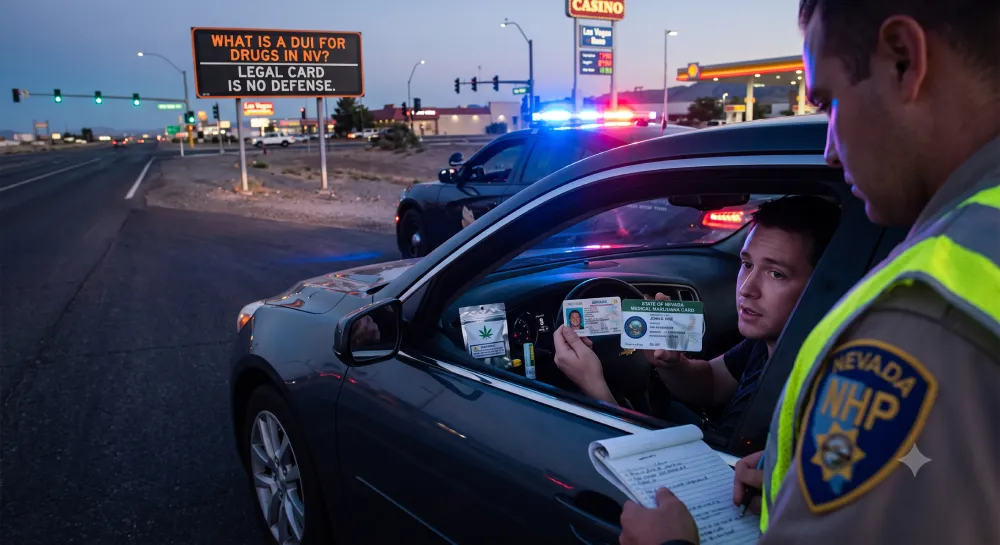
Nevada legalized recreational cannabis. Medical cards are widely held. But thousands of people every year find out the hard way that legal marijuana and legal driving are two entirely different conversations — and the law does not care which dispensary sold it to you.
Nevada residents voted to legalize recreational marijuana in 2016. Dispensaries are on almost every major corridor in Las Vegas. Medical cannabis cards are held by hundreds of thousands of Nevadans. And yet every single week, people are arrested for driving under the influence of marijuana right here in Clark County — many of them genuinely believing that because they were using a legal product, they could not possibly have been breaking any law.
That belief is wrong. And it is one of the costliest misconceptions on Nevada roads today.
Legal marijuana and legal marijuana impaired driving are two completely different things under Nevada law. The same NRS 484C.110 that criminalizes drunk driving also criminalizes drug-impaired driving — including marijuana, regardless of whether you have a medical card, regardless of where you bought it, and regardless of whether the state considers it a legal substance for adults to consume. The law does not ask where your cannabis came from. It asks whether you were impaired behind the wheel when you were stopped.
But here is the part that makes marijuana DUI cases genuinely different from alcohol DUI cases — and why they are often more defensible: there is no breathalyzer for marijuana. There is no standardized roadside test. There is no widely accepted science linking a specific blood level of THC to actual driving impairment. And THC can linger in the body for days or even weeks after a person has stopped feeling any effects at all.
That combination — aggressive prosecution with legitimately weak scientific evidence — is exactly where an experienced attorney can make a real difference. For over 30 years, The Law Offices of Michael I. Gowdey, LTD has defended clients facing DUI charges in Las Vegas, Henderson, North Las Vegas, and throughout Nevada. Marijuana DUI cases are winnable cases. But only with the right approach.
What Every Nevada Driver Needs to Know About Marijuana DUI
- Yes — you can absolutely get a DUI for marijuana in Nevada even if it is legal and even if you have a valid medical card. The legality of the substance is completely irrelevant under NRS 484C.110.
- For first and second DUI offenses within 7 years, prosecutors must prove actual impairment — they cannot convict you based on a blood test result alone.
- For a third or subsequent DUI within 7 years, the rule changes drastically: 2 ng/mL of delta-9-THC or 5 ng/mL of the metabolite (11-OH-THC) in your blood is automatically a per se DUI — even if you were not impaired.
- THC can stay in your blood for days or weeks after consuming marijuana — long after any actual high has worn off. A positive blood test does not prove you were impaired at the time of driving.
- There is no standardized roadside test for marijuana impairment anywhere in the United States. Officers use field sobriety tests and Drug Recognition Experts — both of which are highly subjective and challengeable.
- In a drug DUI case, you must submit to a blood test (not a breathalyzer). Refusing triggers a 1-year license revocation and police can obtain a warrant for a forced blood draw.
- A marijuana DUI carries the same penalties as an alcohol DUI — same jail time, same fines, same license revocation, same DUI school requirements.
- Drug Recognition Expert testimony is a subjective opinion, not scientific measurement. Experienced attorneys regularly challenge and defeat it in court.
- The 7-day DMV hearing deadline applies equally to drug DUI cases — miss it and your license is automatically suspended.
2 ng/mL
Per se THC limit (3rd+ DUI only) under NRS 484C.110(4)
0 Days
How long you can wait — 7-day DMV hearing deadline starts at arrest
2–4 Weeks
How long THC can remain detectable in blood for regular users
12 Steps
DRE evaluation protocol — all subjective, all challengeable in court
Can You Get a DUI for Marijuana in Nevada Even If It Is Legal?
Let’s get this one completely out of the way right at the start: yes, absolutely, unambiguously.
Nevada legalized recreational marijuana for adults 21 and older under state law. You can legally possess up to 2.5 ounces. You can legally purchase from a licensed dispensary. You can legally consume in a private residence. A medical marijuana card gives you additional legal protections for possession and use. None of that changes what happens when you get behind the wheel.
NRS 484C.110 defines driving under the influence as operating a vehicle while impaired by any controlled substance, drug, or chemical — period. The statute does not carve out an exception for substances that are legal under Nevada law. It does not ask whether you have a medical card. It does not distinguish between cannabis purchased at a licensed dispensary and anything else. If your ability to drive safely is compromised by marijuana, you are committing a DUI.
The Nevada courts and the legislature have been clear on this point. Even after legalization, the DUI statute applies fully and completely to marijuana impairment. The legality of the substance is simply not a defense.
Medical Card Holders — This Applies Equally to You
A Nevada medical marijuana card authorizes you to possess and use cannabis under state law. It does not create any protection or exemption for driving while impaired. Courts have been explicit: your prescription or medical card is not a defense to marijuana DUI charges under NRS 484C.110. The same standard applies whether you smoke recreationally on a Friday night or use a cannabis product for legitimate medical reasons under a doctor’s care.
What Is the Legal Limit for THC While Driving in Nevada?
This is where Nevada’s marijuana DUI law gets genuinely complicated — and where it differs significantly from how most people assume it works.
For alcohol, the rule is simple: 0.08% BAC, and you are presumed impaired. But Nevada’s approach to marijuana is fundamentally different, and it changed significantly in 2021 when the state passed AB 400.
For First and Second DUI Offenses — Impairment Must Be Proven
Under the current law, for a first or second marijuana DUI within 7 years, there is no BAC-style per se limit. The prosecution cannot convict you simply by pointing to your blood THC levels. They must prove that marijuana impaired you to a degree that rendered you incapable of safely driving. The amount in your blood matters, but it is not automatically the whole story.
This is a meaningful legal protection — and one that creates real opportunities for an experienced defense attorney. THC behaves very differently from alcohol in the body. Regular cannabis users can have significant amounts of THC in their bloodstream while experiencing no meaningful impairment at all, because their bodies have developed tolerance. Infrequent users might show less THC on a blood test but be far more functionally impaired. The science simply does not support a clean, linear relationship between THC blood levels and impaired driving ability.
For Third or Subsequent DUI Offenses — The Per Se Rule Kicks In
Once you are facing a third or subsequent DUI within 7 years, the rules change dramatically. Under NRS 484C.110(4), you can be convicted automatically if your blood shows:
- 2 nanograms per milliliter (ng/mL) of delta-9-THC (the main psychoactive compound in marijuana), OR
- 5 ng/mL of 11-OH-THC (a marijuana metabolite)
At this level, the prosecution does not need to prove you were impaired. The blood test result alone is sufficient for a conviction — which is exactly what “per se” means in DUI law. This is the same legal framework that applies to alcohol at 0.08%.
The Metabolite Problem — Something Almost Nobody Talks About
THC metabolites — byproducts of how your body processes cannabis — can remain in your bloodstream for days or even weeks after you have consumed marijuana and are experiencing zero impairment whatsoever. For regular users, these metabolites can persist for two weeks or longer. This creates a scenario where a person who last smoked marijuana four days ago, is completely sober, and can drive perfectly safely could still test positive for 11-OH-THC metabolites and face a per se DUI conviction if it is their third offense. Challenging the meaning of metabolite results — separating residual metabolites from actual impairment — is one of the most important defenses in third-offense marijuana DUI cases.
How Does Nevada Test for Drug Impairment During a Traffic Stop?
This is where the structural weakness of marijuana DUI prosecution becomes most apparent — and where defense attorneys have the most to work with. Because unlike alcohol, there is no equivalent of a breathalyzer for marijuana. Not in Nevada. Not anywhere in the United States. As Fox5 Las Vegas reported in April 2026, high-profile marijuana DUI cases moving through Nevada courts are highlighting exactly this problem: police rely almost entirely on observations and opinions, not objective scientific measurements.
Here is the process, step by step:
Step 1: The Initial Traffic Stop and Observation
The officer pulls you over — for a traffic violation, erratic driving, or as part of a checkpoint. They start observing for signs of impairment: dilated pupils, bloodshot eyes, the smell of marijuana, slurred speech, slow reaction time, unusually relaxed or agitated behavior. These are all subjective observations made by a person who, in many cases, has already decided they suspect impairment before the evaluation formally begins.
Step 2: Field Sobriety Tests
Standard field sobriety tests — the horizontal gaze nystagmus (eye tracking), walk-and-turn, and one-leg stand — were specifically designed and validated for detecting alcohol impairment. Their reliability for detecting marijuana impairment is scientifically debated and considerably less established. A number of medical conditions, physical disabilities, nervousness, uneven road surfaces, and even the footwear you happen to be wearing that day can all affect your performance on these tests independently of any drug use.
Step 3: The Preliminary Breath Test (PBT)
The officer will ask you to take a roadside breathalyzer test. If you pass it — meaning your alcohol BAC is within legal limits — but still appear impaired, this is actually a signal to the officer that drugs rather than alcohol may be involved. Passing the breath test does not end the stop. In many cases, it escalates it.
Step 4: Drug Recognition Expert (DRE) Evaluation
At this point, officers with specialized training in drug impairment — called Drug Recognition Experts or DREs — may be called to the scene or to the station. DREs are trained in a standardized 12-step evaluation protocol developed by the International Association of Chiefs of Police. The 12 steps include:
1. Breath alcohol test review
2. Interview with arresting officer
3. Preliminary examination / first pulse
4. Eye examinations (HGN, VGN, LOC)
5. Divided attention tests (FSTs)
6.Vital signs / second pulse
7. Dark room examinations (pupils)
8. Muscle tone examination
9. Check for injection sites / third pulse
10. Suspect interview
11. DRE opinion and toxicology request
12. Toxicology confirmation (blood/urine)
After completing all 12 steps, the DRE forms an opinion about whether you are impaired and what category of drug they believe caused it. This opinion is then used as evidence in your prosecution. Here is the critical legal reality: a DRE opinion is a subjective assessment, not a scientific measurement. No instrument produces an objective number. No test has been validated with the same rigor as an alcohol breathalyzer. Defense attorneys regularly challenge DRE testimony — and regularly succeed in raising enough doubt to significantly impact the outcome of cases.
Step 5: Mandatory Blood Test
Under Nevada’s implied consent law, if you are arrested on suspicion of a drug DUI, you are required to submit to a blood test — not a breath test, because breathalyzers only measure alcohol. As we discussed in our breathalyzer refusal guide, refusing a chemical test triggers a 1-year automatic license revocation and allows police to obtain a warrant for a forced blood draw. The difference here is that the test will be a blood draw, which the state then sends to a crime lab for analysis.
The Chain-of-Custody Question
Blood samples in Nevada DUI cases must be handled, stored, and analyzed according to strict protocols. The lab technicians must hold current certification. The chain of custody from draw to analysis must be documented and unbroken. Any break in this chain — improper storage, expired certification, contamination risk — can be grounds to challenge the blood test results entirely. An experienced attorney investigates every one of these procedural requirements before deciding how to defend a case.
What Are the Penalties for a Drug DUI in Nevada?
Here is the thing that consistently shocks people when they find out: a drug DUI in Nevada carries exactly the same penalties as an alcohol DUI. Not “similar.” Not “in the same ballpark.” Identical.
| Offense | Classification | Jail Time | Fine | License | Other |
|---|---|---|---|---|---|
| 1st Drug DUI (within 7 years) | Misdemeanor | 2 days–6 months (or community service) | $400–$1,000 | 90-day revocation | DUI school, victim impact panel, possible treatment |
| 2nd Drug DUI (within 7 years) | Misdemeanor | 20 days–6 months (SB 309, eff. Oct. 2025) | $750–$1,500 | 1-year revocation | IID required, mandatory treatment program |
| 3rd Drug DUI (within 7 years) | Category B Felony | 1–6 years state prison | $2,000–$5,000 | 3-year revocation | No probation, felony DUI court possible |
| Drug DUI Causing Injury/Death | Category B Felony | 2–20 years prison | $2,000–$5,000 | 3-year revocation | Civil liability, restitution |
Note that Senate Bill 309, which took effect October 1, 2025, doubled the minimum jail time for second DUI offenses from 10 to 20 days — and this applies equally to drug DUIs, not just alcohol. You can read more about the SB 309 changes on our full DUI defense page.
The consequences that do not appear in any penalty chart but are equally real: a DUI conviction stays on your criminal record for 7 years in Nevada. It can affect professional licensing, including gaming work cards. It can affect your ability to rent housing. It can have immigration consequences for non-citizens. It affects auto insurance rates for years. And a felony drug DUI conviction affects voting rights, firearm ownership rights, and the ability to seal the record for a significant period.
Is a Drug DUI Treated Differently Than an Alcohol DUI in Nevada?
The penalties are identical. But the way these cases are built — and the way they are defended — is genuinely different, and it is those differences that create real opportunities for people charged with marijuana DUI.
| Feature | Alcohol DUI | Marijuana / Drug DUI |
|---|---|---|
| Roadside test | Breathalyzer — objective number, immediate results | No equivalent test exists anywhere in the U.S. |
| Per se legal limit | 0.08% BAC for all DUI offenses | No per se limit for 1st/2nd offense; 2 ng/mL THC only for 3rd+ |
| What prosecution must prove (1st/2nd) | BAC at or above limit, OR impairment | Actual impairment only — blood test result alone is not enough |
| Testing method after arrest | Breath or blood test | Blood test only (breath tests cannot detect drugs) |
| Does legal possession help the defense? | N/A — alcohol was never illegal | No — legal marijuana does not create a driving defense |
| Can test positive while sober? | No — alcohol clears within hours | Yes — THC metabolites can remain for days or weeks after last use |
| Impairment evidence | Primarily objective (BAC number) | Primarily subjective (DRE observations, field sobriety tests) |
| Scientific standard for impairment | Well-established, widely accepted | Contested, evolving — no universally accepted standard in U.S. courts |
That bottom row — the contested science — is the most important thing to understand about marijuana DUI cases in Nevada. As Fox5 Las Vegas has reported extensively, even high-profile cases moving through Nevada courts are struggling with the fundamental problem that there is no standardized, scientifically validated test for marijuana intoxication while driving. Officers and DREs are testifying to their observations and opinions. That is defensible territory.
Prescription Medications and Over-the-Counter Drugs
The same NRS 484C.110 that covers marijuana also covers every other controlled substance, prescription medication, and even some over-the-counter drugs that cause impairment. A prescription opioid, a benzodiazepine, a sleeping medication, an antihistamine taken for allergies — if any of these drugs impairs your ability to drive safely, you are committing a DUI in Nevada. Having a valid prescription is explicitly not a defense under Nevada law. This catches a surprising number of people who are taking medication exactly as prescribed and still face DUI charges because an officer observed signs of impairment during a traffic stop.
How Can Marijuana DUI Charges Actually Be Beaten in Nevada?
These cases are more defensible than most people realize. Here is where experienced attorneys find leverage.
Challenge the Traffic Stop Itself
Every drug DUI prosecution begins with a traffic stop. The officer must have had reasonable suspicion — a specific, articulable reason — to pull you over in the first place. If the stop was not legally justified, every piece of evidence gathered after it — the field sobriety tests, the DRE evaluation, the blood draw — can be suppressed. No evidence, no case. This is one of the most powerful pretrial motions in DUI defense.
Challenge the DRE Evaluation
DRE testimony is subjective. A trained defense attorney can expose flaws in the evaluation — steps performed out of order, steps skipped, failure to consider alternative explanations for physical symptoms (medical conditions, anxiety, fatigue, prescription medications), improper test administration, and bias. Courts do not treat DRE opinions as infallible science, and juries — properly educated on the limitations of this evaluation — often reach the same conclusion.
Separate Metabolites from Actual Impairment
For third-offense cases where per se THC levels are at issue, the critical argument is that the presence of metabolites in blood does not prove impairment. THC and its metabolites can remain in the body long after any psychoactive effect has ended. Expert witnesses — toxicologists, pharmacologists — can testify about how THC behaves in the body over time and explain why a positive blood test does not mean your client was impaired when they were driving.
Challenge the Blood Test Procedures
Chain of custody, lab certification, storage protocols, analyst qualifications — these are all procedural requirements that must be satisfied exactly. If they were not, the test results can be challenged. This is not a technicality — it is the science of ensuring that the evidence presented in court is actually reliable.
Lack of Actual Impairment Evidence
If the driving that precipitated the stop was entirely normal — you were pulled over for a broken tail light, not for swerving — and if your performance on the field sobriety tests was reasonable — and if there is no video showing erratic behavior — the prosecution’s case may rest entirely on a blood test result that, for first and second offenses, cannot legally convict you. That is a case worth fighting.
MG
Attorney Michael I. Gowdey — 30+ Years Defending DUI Cases in Nevada
Drug DUI cases — and marijuana DUI cases in particular — sit at the intersection of evolving law, contested science, and high stakes. They require an attorney who understands the chemistry of THC, the limitations of DRE testimony, the specific protocols that govern blood draws in Clark County, and the 7-day DMV deadline that starts ticking the moment of arrest. That is the kind of experience Attorney Michael I. Gowdey brings to every case — built over three decades in Nevada courts, handling DUI cases involving alcohol, marijuana, prescription drugs, and other controlled substances. Multiple awards. Local knowledge. A commitment to fighting with strategy, empathy, and heart.
Schedule Your Free Consultation →
What Does the Marijuana DUI Landscape Look Like Right Now in Las Vegas and Clark County?
The legal and enforcement environment around marijuana DUI in Nevada is shifting rapidly, and what is happening right now in Clark County is worth understanding.
Fox5 Investigates reported in April 2026 that multiple high-profile marijuana DUI cases were actively moving through Nevada courts at the same time, all highlighting the same central problem: there is no standardized test for cannabis intoxication, meaning prosecutions rely heavily on the subjective observations of officers and DREs. In one of those cases, a suspect was alleged to have caused a 12-car crash that killed three people — including his pregnant girlfriend — and police found a marijuana vape device in the car. In another, former NBA player Lamar Odom was arrested after troopers said he was traveling at 100 miles per hour while impaired, failing field sobriety tests after officers smelled marijuana from his vehicle.
These cases illustrate both the serious real-world consequences of driving while impaired by marijuana and the fundamental challenge prosecutors face in proving it. When the evidence comes down to “the officer smelled marijuana and the driver failed a sobriety test,” the defense has real work to do — and real arguments to make.
Clark County’s overall DUI enforcement remains intensive. The same data that shows 6,159 DUI arrests in Clark County in 2024 includes a growing proportion of drug-related cases as marijuana has become more normalized. LVMPD, Henderson PD, and North Las Vegas PD all employ DREs and have specifically trained units for drug-impaired driving enforcement. The system is set up to build these cases aggressively. You need someone who knows how to dismantle them.
Do Not Wait — the 7-Day Clock Starts at Arrest
Drug DUI arrests trigger the same 7-day DMV hearing deadline as alcohol DUI arrests. If you do not request that hearing in writing within 7 days, your license is automatically suspended on day 8. An attorney can request that hearing on your behalf and fight to preserve your driving privileges while your criminal case is pending. Contact The Law Offices of Michael I. Gowdey, LTD immediately after any DUI arrest — drug or alcohol.
Top 10 Questions People Ask Drug and Marijuana DUI Lawyers in Nevada
1 Can I get a DUI in Nevada just for having a medical marijuana card?
Having a medical marijuana card does not protect you from a DUI charge. The card authorizes legal possession and use of cannabis in Nevada — it does not create any exemption for driving while impaired. Under NRS 484C.110, any person whose driving ability is impaired by marijuana can be charged with DUI, regardless of whether their use was medicinal or recreational and regardless of whether they purchased their cannabis legally. The courts are very clear on this: medical authorization to use a substance is not a defense to driving while impaired by it.
2 What is the legal THC limit for driving in Nevada?
For a first or second DUI offense within 7 years, there is no BAC-style per se limit for marijuana in Nevada. Prosecutors must prove actual impairment — they cannot convict you based solely on your blood THC level. For a third or subsequent DUI within 7 years, the per se rule applies: 2 ng/mL of delta-9-THC or 5 ng/mL of the 11-OH-THC metabolite in blood is sufficient for a conviction even without proof of impairment. This is a crucial distinction that determines the entire defense strategy in a marijuana DUI case.
3 I smoked marijuana two days ago. Can I still get a DUI in Nevada even if I am completely sober now?
This is one of the most important — and most disturbing — aspects of Nevada’s marijuana DUI law. THC and its metabolites can remain detectable in blood for days or even weeks after consumption, particularly in regular users, long after any psychoactive effect has ended. For a first or second offense, this creates a strong defense: you can argue that the blood test results reflect residual metabolites, not active impairment. For a third offense where per se limits apply, the presence of metabolites in your blood alone can technically support a conviction even if you were not experiencing any impairment. Challenging what those test results actually mean is the central defense strategy in these cases.
4 What happens if I refuse a blood test after a drug DUI arrest in Nevada?
Refusing a blood test after a drug DUI arrest triggers the same consequences as refusing a breathalyzer after an alcohol DUI: automatic 1-year license revocation under Nevada’s implied consent law, and officers can obtain a telephonic warrant within minutes and proceed with a forced blood draw. Additionally, your refusal can be used as evidence against you in court, with prosecutors arguing you refused because you knew you would fail the test. In most drug DUI cases, refusal creates more legal problems than it solves — especially since police are often going to get the blood draw anyway.
5 What is a Drug Recognition Expert (DRE) and can their testimony be challenged?
A Drug Recognition Expert is a law enforcement officer who has received specialized training in identifying signs of drug impairment. DREs follow a standardized 12-step evaluation protocol developed by the International Association of Chiefs of Police. After completing the evaluation, they form an opinion about whether a driver is impaired and what category of drug is likely responsible. Critically, this is a subjective professional opinion — not a scientific measurement. DRE testimony can be challenged on multiple grounds: the evaluation was not conducted according to protocol, steps were skipped or performed incorrectly, alternative medical explanations were not considered, or the officer’s conclusions are not supported by the physical evidence in the blood test results.
6 Is a drug DUI treated the same as an alcohol DUI in Nevada courts?
The penalties are identical — same jail time, same fines, same license revocation periods, same DUI school requirements. However, the way these cases are built and defended is significantly different. Alcohol DUI cases center on an objective BAC number. Marijuana and drug DUI cases for first and second offenses require the prosecution to prove actual impairment through subjective evidence — field sobriety tests, DRE evaluations, officer observations. This evidentiary difference creates real opportunities for defense attorneys that simply do not exist to the same degree in alcohol DUI cases.
7 Can I get a drug DUI while sitting in a parked car in Nevada?
Yes. Nevada’s DUI law applies to anyone who is in “actual physical control” of a vehicle — not just someone who is actively driving. If you are sitting in the driver’s seat with the keys accessible and the ability to operate the vehicle, you can be found in actual physical control even if the car is not moving and the engine is off. People who pull over to “sleep it off” in the front seat have been arrested for DUI in Nevada. If you are impaired, the safest legal position is to be in the back seat with the keys away from the driver’s area — though even this is not a guaranteed protection from charges.
8 Can a marijuana DUI charge be reduced to reckless driving in Nevada?
Yes — a reduction to reckless driving is one of the most valuable outcomes in a marijuana DUI case. Reckless driving carries significantly lighter penalties and does not carry the same stigma, record implications, or collateral consequences as a DUI conviction. Prosecutors are more likely to consider this reduction when the impairment evidence is weak, when the blood test results are for metabolites rather than active THC, or when the traffic stop itself was questionable. An experienced DUI defense attorney knows how to build the factual and legal case that makes this negotiation possible.
9 Does a drug DUI affect my ability to work in the gaming industry in Las Vegas?
A DUI conviction — whether for alcohol or drugs — is a significant negative factor in any Nevada Gaming Control Board background check. Gaming work cards, gaming agent licenses, and gaming operator licenses all require applicants to disclose and explain any criminal convictions. A drug DUI involving marijuana can raise additional concerns given the ongoing federal prohibition on cannabis, which creates complications for licensed gaming properties that are subject to federal oversight. An employer holding federal licenses may view any drug-related conviction differently than a straight alcohol DUI. This is one of the most important practical reasons to fight a marijuana DUI charge aggressively from the very beginning.
10 How does a marijuana DUI affect my record and can it be sealed in Nevada?
A DUI conviction — drug or alcohol — remains on your criminal record for 7 years in Nevada and cannot be sealed during that period, even if it was a first misdemeanor offense. After 7 years from the date your case fully closes, you can petition to have a misdemeanor DUI sealed. A felony DUI carries a longer waiting period. If the case is dismissed entirely, you can petition for an immediate seal. This is why the outcome of the case matters so much for your long-term future — a dismissal, a reduction to reckless driving, or even a conditional dismissal through a DUI court program all create far better paths to a clean record than a straight DUI conviction.
The Law Offices of Michael I. Gowdey, LTD
Justice with Integrity | Representation with Heart
Serving Las Vegas · Henderson · North Las Vegas · All of Nevada — gowdeylaw.com/
This page is for general informational purposes only and does not constitute legal advice. Reading this page does not create an attorney-client relationship. Every case is unique — contact our office directly to discuss the specifics of your situation.