
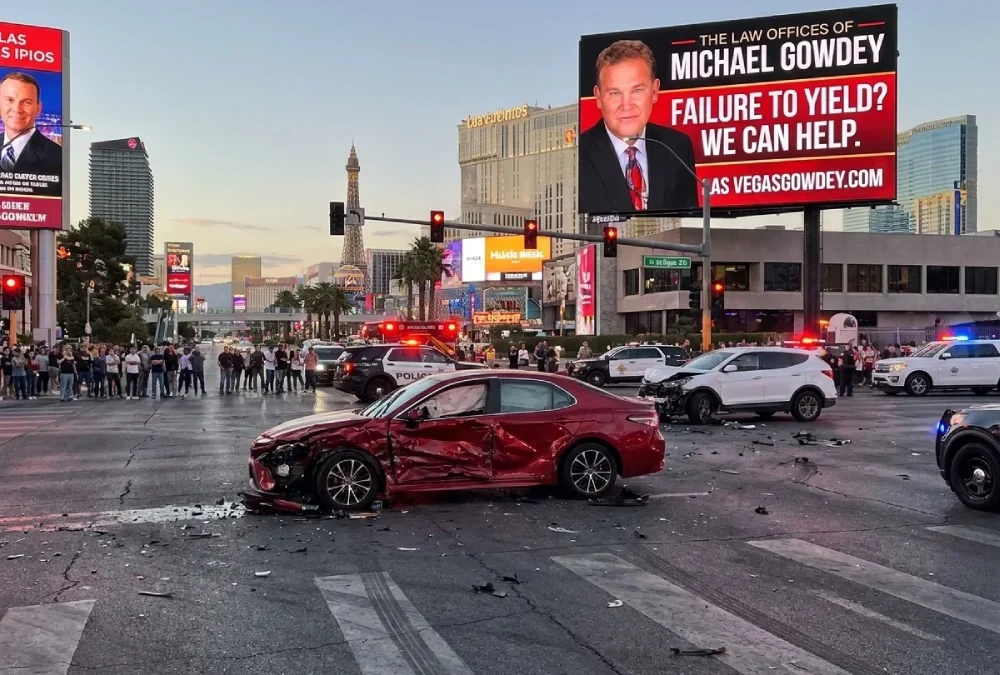
You are driving home from work. The light turns green, so you pull into the intersection. Suddenly, another car slams into your side. Your airbags deploy. Glass is everywhere. Now you are sitting in a hospital bed in terrible pain. You are worrying about your ruined car and how you will pay your medical bills.
Then the other driver’s insurance company calls. They try to blame you for the crash. You know you had the right of way, but how do you prove it?
My name is Michael I. Gowdey. I have fought for accident victims in Clark County for over 30 years as a trial lawyer. When two cars crash in an intersection, the insurance companies always point fingers. Their goal is to save money, not to find the truth. I know how to stop their games. Here is the honest truth about how fault is determined in a Las Vegas intersection collision.
Key Takeaways
- Nevada right-of-way laws dictate exactly who is allowed to enter an intersection first.
- The driver who fails to yield is almost always at fault for the collision.
- You can still win money if you are partially blamed, as long as you are not 51 percent or more at fault.
- Never give a recorded statement to the other driver’s insurance company without a lawyer.
Who has the right of way at a Nevada intersection?
Under Nevada law, you must yield to drivers already in the intersection or those arriving first. If two vehicles arrive at an open intersection at the exact same time, the driver on the right always has the legal right of way to proceed first.
To determine who caused a crash, we must first figure out who had the right to be there. Nevada Revised Statute (NRS) 484B.250 lays out the rules of the road. [Insert link to NV .gov source on NRS 484B.250]. The law is very clear. A right of way simply means who gets to go first.
If you are turning left, you must yield to oncoming traffic. If you have a yield sign, you must wait for cars on the main road to pass. When people ignore these simple rules, they cause devastating side-impact crashes. These are often called “T-bone” collisions, and they cause massive injuries.
How do police determine fault after a Las Vegas crash?
Las Vegas Metropolitan Police determine fault by looking at physical evidence, witness statements, and traffic camera video. They match this evidence against Nevada right-of-way laws to see who failed to yield, ran a red light, or ignored a stop sign.
When Metro Police arrive at a crash scene, they look for clues. They measure skid marks on the road. They look at where the cars ended up. They look at the damage on each vehicle. If the front of the other car is smashed into the side of your car, it clearly shows they hit you.
The police officer will write an official crash report. In this report, the officer usually states who failed to yield. My team uses this report in Clark County District Court to prove the other driver was negligent. [Insert accurate Clark County statistic here regarding annual intersection crashes].
Common Mistakes to Avoid After a Crash
- Saying “I am sorry.” The other driver can twist this into an admission of guilt.
- Refusing to call the police. You need an official report to prove what happened.
- Leaving the scene too early. Stay until the police tell you it is okay to leave.
- Talking to the other driver’s insurance. They will record your call and use your words against you.
What if the traffic lights were broken during my crash?
If a traffic light is broken or flashing red, Nevada law treats the intersection exactly like a four-way stop. Every driver must come to a complete stop and yield to the vehicle that arrived first, or the vehicle on the right.
Power outages happen in Las Vegas. When the lights go out, drivers often panic. Some drivers just speed right through the dark intersection. That is illegal. Under Nevada law, a broken traffic signal becomes a stop sign. If someone hits you because they failed to stop at a broken light, they are entirely at fault for the crash.
Nevada Right-of-Way Rules at a Glance
| Crash Situation | Who Has the Right of Way? | Nevada Law (NRS) |
| Arriving at an open intersection at the same time | The car on the right side | NRS 484B.250 |
| A driver wants to turn left | Oncoming traffic going straight | NRS 484B.250 |
| Driver is at a stop sign or yield sign | Traffic already on the main road | NRS 484B.257 |
| Entering the main road from a private driveway | Cars already traveling on the street | NRS 484B.260 |
Can I still get money if I was partially at fault?
Yes, you can still recover money under Nevada’s modified comparative negligence law as long as you were less than 51 percent at fault. However, a judge or jury will reduce your final financial payout by your exact percentage of fault.
The other driver’s insurance company will try to blame you. They might say you were speeding or that you took too long to cross the intersection. They do this to save money.
Nevada uses a rule called “modified comparative negligence.” If a jury decides you were 20 percent at fault, and your medical bills are $100,000, you will only get $80,000. But if they trick the jury into believing you were 51 percent at fault, you get zero. Nothing. This is why you need a fierce trial lawyer to protect your rights. [Internal Link: Las Vegas Personal Injury page].
What to Do in the First 24 Hours
- Call 911. Make sure the police come to the scene and write a report.
- Take photos. Take pictures of the cars, the traffic lights, the skid marks, and your injuries.
- Get witness info. Write down the names and phone numbers of anyone who saw the crash.
- Go to the doctor. Even if you just feel sore, get checked out. This creates a medical record of your injuries.
- Call my office. My team will contact the insurance companies so you do not have to speak to them.
Frequently Asked Questions About Intersection Collisions
Who is at fault when someone turns left and crashes?
Usually, the driver turning left is at fault. Nevada law requires left-turning drivers to yield to oncoming traffic. Unless the oncoming driver ran a red light or was speeding recklessly, the left-turning driver takes the blame.
Do I need a police report to prove fault?
Yes. A police report is the most important piece of evidence. Without it, the insurance companies will just argue over who is telling the truth.
What if there were no witnesses to the crash?
If there are no witnesses, my firm looks for other evidence. We search for nearby security cameras, dashcam video, and physical evidence like skid marks to prove your story.
How do I get traffic camera footage in Las Vegas?
Traffic cameras delete footage quickly. My team sends a legal demand letter to the city or county right away to force them to save the video before it disappears.
Does the person who rear-ended me at a stop light automatically take the blame?
Almost always. If you are stopped safely at a red light or stop sign and someone hits you from behind, they are at fault. They failed to control their speed and distance.
Can I be blamed if the other driver ran a red light but I was speeding?
Yes, you might share some of the blame. If you were speeding, the insurance company will argue you could have stopped in time if you were driving the speed limit. We have to fight this to keep your percentage of fault low.
How long do I have to file a lawsuit after an intersection crash?
In Nevada, you have exactly two years from the date of the crash to file a personal injury lawsuit. If you wait too long, the court will throw your case out.
Get Representation with Heart Today
An intersection crash leaves you with a broken car, serious pain, and a mountain of stress. The insurance companies have armies of lawyers trying to blame you. You do not have to fight them alone.