
Marijuana: Legal But Still Complicated
Nevada legalized recreational marijuana use for adults 21 and older in 2017, and today cannabis dispensaries operate throughout Las Vegas, Henderson, and North Las Vegas. Under NRS Chapter 678D, adults may legally possess up to 1 ounce of marijuana flower or up to 3.5 grams of concentrate.
So what’s still illegal?
- Possession of more than 1 ounce is a misdemeanor for a first offense; repeat offenses and larger quantities carry more serious penalties
- Possession on federal land — including Hoover Dam, Lake Mead, national parks, and federal buildings — remains a federal crime regardless of Nevada law
- Driving under the influence of marijuana is a DUI offense, subject to the same penalties as alcohol DUI
- Sale or distribution without a state license is a felony
- Possession on school property carries enhanced penalties
Despite legalization, our office continues to handle marijuana-related charges regularly — most often involving quantities over the legal limit, alleged distribution, or DUI. If you’re facing marijuana charges, the Nevada Cannabis Compliance Board provides regulatory context, but what you need most is an experienced criminal defense attorney.
Schedule I and II Controlled Substances: Where the Law Gets Serious
Methamphetamine, cocaine, heroin, fentanyl, MDMA, LSD, and prescription medications possessed without a valid prescription all remain illegal in Nevada. These substances are classified under Nevada’s Uniform Controlled Substances Act, and the penalties depend heavily on the schedule of the substance and the quantity involved.
Under Nevada law, first-offense simple possession of most controlled substances is now a Category E felony — the lowest felony category — carrying a presumptive sentence of 1 to 4 years in prison, with probation typically available for first-time offenders. Prior to Nevada’s 2017 reforms, simple possession was treated as a higher-level felony across the board. The change was significant, but a Category E felony is still a felony — with all the lifelong consequences that carries.
Here’s the current framework for controlled substance possession in Nevada:
- First offense, simple possession (most Schedule I/II substances): Category E felony, 1–4 years (probation typically available), fines up to $5,000
- Second offense: Category E felony, same range but courts less likely to grant probation
- Third or subsequent offense: Category D felony, 1–4 years, higher fines
- Possession with intent to sell: Category B or C felony depending on substance and quantity, 1–20 years
- Drug trafficking (large quantities): Category A felony, mandatory prison terms, no probation
Drug Trafficking: A Completely Different Category
Nevada’s drug trafficking laws are not about dealing on street corners. Trafficking is triggered entirely by quantity — and the quantity thresholds are lower than most people expect. If you are caught with more than a specified amount of a controlled substance, the presumption under Nevada law is that the possession is for sale, regardless of your intent.
Nevada trafficking thresholds (NRS 453.3385):
- Methamphetamine: 4 grams or more triggers trafficking
- Cocaine: 28 grams or more
- Heroin: 4 grams or more
- Fentanyl: 4 grams or more
Drug trafficking is a Category B felony at minimum and a Category A felony at higher quantities. Category A trafficking carries mandatory sentences of 25 years to life in prison with no possibility of probation or suspension of sentence. The Nevada Legislature’s controlled substances chapter contains the full schedule of trafficking thresholds and penalties.
If you’re facing trafficking charges, please visit our drug trafficking defense page immediately. These cases are handled entirely differently from simple possession, and the stakes are extraordinarily high.
Drug Courts and Diversion Programs in Clark County
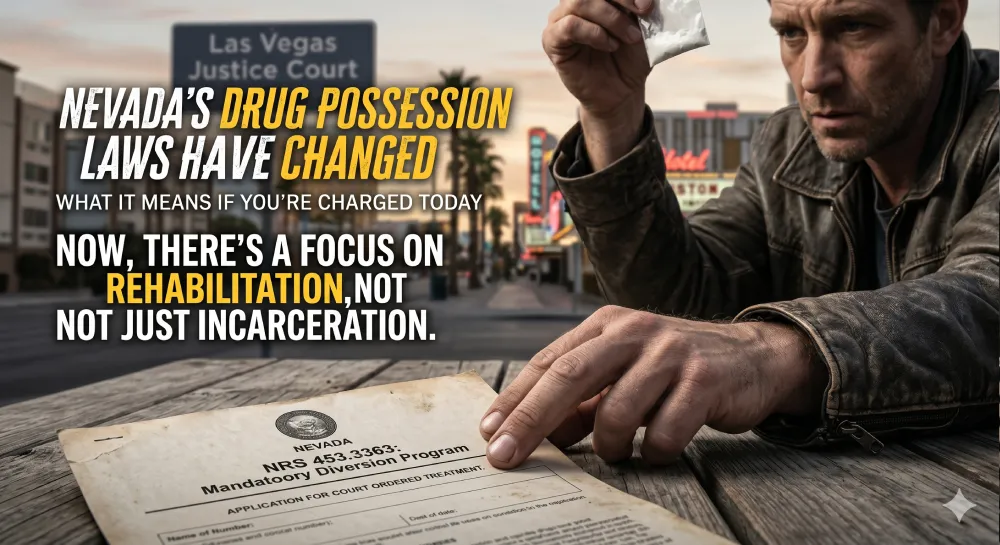
Clark County operates several drug court programs that allow eligible defendants to resolve drug charges through treatment rather than traditional prosecution. The Clark County Drug Court is a nationally recognized program that has helped thousands of Las Vegas Valley residents overcome addiction and clear their records.
Eligibility for drug court typically requires:
- A non-violent offense
- No prior felony convictions for violent crimes
- Substance use disorder as a contributing factor
- Willingness to participate in intensive supervision and treatment
Successful completion of drug court typically results in the dismissal of charges, with the case then eligible for sealing. An attorney who regularly works with Clark County Drug Court — as Michael Gowdey does — can help evaluate whether you’re a good candidate and navigate the application process.
Common Defense Strategies in Nevada Drug Possession Cases
The outcome of a drug possession case depends heavily on the quality of the legal defense. Here are the most powerful strategies we employ:
Fourth Amendment Challenges: The Illegal Search
The Fourth Amendment to the U.S. Constitution prohibits unreasonable searches and seizures. If police in Las Vegas, Henderson, or North Las Vegas found drugs through an unconstitutional search — stopping you without reasonable suspicion, searching your car without proper consent or a warrant, or conducting a home search that exceeded the scope of a warrant — the evidence can be suppressed. Evidence obtained in violation of the Fourth Amendment generally cannot be used at trial, which often results in dismissal. The ACLU of Nevada maintains useful resources on search and seizure rights.
Challenging Constructive Possession
Not every drug found in proximity to you legally belongs to you. If the drugs were in a shared space — a car with multiple occupants, a shared apartment, a common area — the prosecution must prove beyond a reasonable doubt that you knew about the drugs and exercised control over them. We challenge these cases aggressively when the facts support it.
Chain of Custody and Lab Analysis
Drug evidence must be properly collected, preserved, and analyzed by a certified crime laboratory. Failures in chain of custody, contamination of samples, or errors in lab analysis can undermine the prosecution’s case. We request all lab documentation and, where warranted, retain independent forensic experts.
Entrapment
If law enforcement induced you to commit a drug offense you would not otherwise have committed, you may have an entrapment defense. This arises most often in undercover operations and sting cases. It’s a high bar, but it’s a legitimate defense when the facts support it.
Drug Possession vs. Drug Paraphernalia: Both Carry Consequences
Nevada also criminalizes possession of drug paraphernalia under NRS 453.566. Pipes, syringes, scales, baggies, and other items associated with drug use or sales can result in separate charges alongside — or even without — a drug possession charge. Our drug paraphernalia defense page explains the distinction and the available defenses.
Prescription Drug Charges: A Growing Area of Prosecution
Opioid and benzodiazepine possession without a valid prescription is one of the most rapidly growing categories of drug prosecution in Clark County. Possession of someone else’s Xanax, Adderall, or Vicodin — even a single pill — is a felony under Nevada law. The rise of fentanyl in the Las Vegas drug supply has also led to an increase in prosecutions for possession of substances that turn out to contain fentanyl, even when the defendant believed they were buying a different substance.
If you’re facing prescription drug charges, the specifics matter enormously. A valid prescription in your name, obtained from a licensed physician, is a complete defense. But “I didn’t know it was fentanyl” is more complicated — and requires an experienced attorney.
The Consequences of a Drug Conviction Beyond Jail Time
Drug convictions in Nevada carry consequences that extend far beyond the criminal sentence:
- Federal student loan eligibility: A drug conviction can temporarily or permanently affect eligibility for federal financial aid.
- Professional licensing: Healthcare workers, attorneys, real estate agents, and many other licensed professionals in Nevada must disclose drug convictions and may face license suspension or revocation.
- Public housing: Drug convictions can disqualify individuals and their families from federally subsidized housing.
- Employment: Background checks are standard in Clark County and throughout Nevada. A felony drug conviction significantly narrows employment options.
- Immigration: Drug convictions are among the most serious immigration triggers, potentially resulting in deportation or bar to naturalization.
Serving Las Vegas, Henderson, and North Las Vegas
Attorney Michael Gowdey has represented clients facing drug charges of every kind throughout Clark County for over 30 years. From simple possession in North Las Vegas to trafficking allegations in Henderson and prescription fraud charges in Las Vegas, we know these cases, these courts, and these prosecutors.
If you’ve been charged with a drug offense, you need experienced legal representation immediately. Visit our drug offenses practice page or contact us directly at gowdeylaw.com/contact for a free case analysis. A drug charge is serious — but the outcome is not predetermined.
| Free Case Analysis — Law Offices of Michael I. Gowdey, Ltd. | Las Vegas, Henderson & North Las Vegas | gowdeylaw.com/contact |