
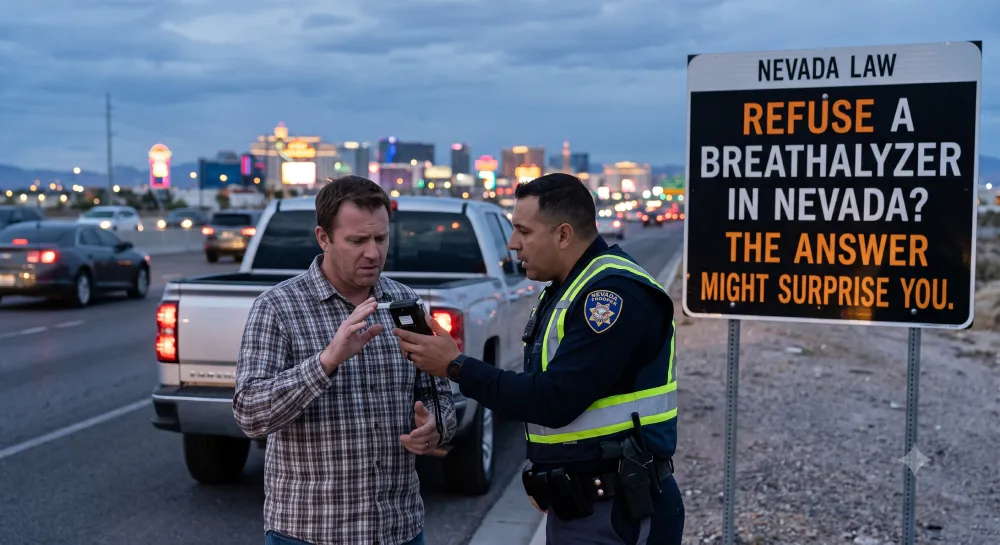
Most people think refusing buys them time. In Nevada, it usually makes everything worse — and in some cases, it hands the prosecution the very evidence they need. Here is exactly what the law says, and what happens next.
Talk to Attorney Gowdey Today →
Picture this. You get pulled over late at night somewhere near the Strip. Or maybe it is a Saturday evening coming home from a birthday dinner in Henderson. The officer walks up to your window and asks you to step out of the car. Then comes the question everyone dreads: “Will you take a breathalyzer test?”
In that moment, a lot of people think the smart play is to say no. “If they do not have my BAC number, they cannot prove anything, right?” It sounds logical. It feels like the safer choice. But in Nevada — and this is important — refusing a breathalyzer is almost never the win people think it is. In fact, in most situations, it makes things considerably worse.
This page is going to walk you through exactly what happens when you refuse a chemical test in Nevada, why the law is set up the way it is, and what you absolutely must do within the first seven days after a DUI arrest to protect your ability to drive. No confusing legal language. Just the facts — explained the way a good friend who happens to be a lawyer would explain them to you over coffee.
And if you are reading this because you — or someone you care about — was just arrested, please keep reading. The decisions made in the next 168 hours matter enormously. The Law Offices of Michael I. Gowdey, LTD has been helping people navigate exactly this situation in Las Vegas, Henderson, North Las Vegas, and throughout Nevada for over 30 years.
Key Takeaways — What You Need to Know Right Now
- Nevada’s implied consent law (NRS 484C.160) means the moment you got your driver’s license, you already agreed to submit to chemical testing if arrested for DUI.
- Refusing a breathalyzer after arrest triggers an automatic 1-year license revocation — even if your DUI charge is later dropped or dismissed entirely.
- You have only 7 days from your arrest date to request a DMV hearing. Miss that window, and your license is automatically suspended on day 8. No exceptions.
- There are two very different tests — the roadside PBT and the post-arrest evidentiary test. The rules for each are completely different. Most people do not know this.
- If you refuse, police can — and routinely do — get a telephonic warrant and force a blood draw. Your refusal did not prevent testing. It just added new legal problems.
- In court, your refusal can be used as evidence of guilt — prosecutors will tell the jury you refused because you knew you were impaired.
- A second refusal within 7 years triggers a 3-year revocation that runs on top of any DUI-related suspension.
- An experienced attorney can challenge almost every aspect of a DUI stop — from the legality of the traffic stop to the calibration of the breathalyzer itself.
7 Days
Window to request a DMV hearing before automatic suspension
1 Year
Automatic license revocation for a first-time refusal in Nevada
6,159
DUI arrests in Clark County in 2024
3 Years
License revocation for a second refusal within 7 years
What Does Nevada’s Implied Consent Law Actually Mean — and Did You Already Agree to Be Tested?
Here is the part that catches most people completely off guard: you already said yes. The moment you got a Nevada driver’s license and drove a car on a public road, the law automatically treated that as consent to chemical testing if you were ever arrested for DUI.
That is what “implied consent” means. You did not sign a piece of paper. Nobody sat down with you and read you the fine print. The agreement is implied — built into the act of driving itself.
Nevada Revised Statute 484C.160 spells this out directly. It says that any person who drives or is in “actual physical control” of a vehicle on a highway or any area the public can access has automatically given consent to a blood, urine, or breath test — if a police officer has reasonable grounds to believe that person was driving under the influence.
Notice what that says: “actual physical control.” This is broader than most people realize. You do not have to be actively driving. If you are sitting in the driver’s seat with the keys in the ignition — even if the car is parked — Nevada courts have found that you may still be in actual physical control. People have been arrested for DUI while sleeping in a parked car. This law covers those situations too.
Something Most People Get Wrong
The implied consent law kicks in after you are lawfully arrested — not the moment you are pulled over. Before arrest, the rules are actually a bit different. Read on, because this distinction matters a great deal for your case.
What Is the Difference Between the Roadside Test and the Official Breathalyzer — and Does It Matter?
This is one of the most important things to understand, and it is something most people — including many who have already been through a DUI stop — do not fully grasp. There are two completely different tests, and the rules around them are not the same at all.
Test #1: The Roadside Preliminary Breath Test (PBT)
This is the handheld device the officer pulls out during the traffic stop, before you are arrested. The officer asks you to blow into it right there on the side of the road. This test is governed by NRS 484C.150.
Here is something critically important about this test: its results cannot be used in court to prove you were driving drunk. That is not a loophole — it is how Nevada law works. The PBT is a screening tool that helps the officer decide whether there is probable cause to arrest you. Full stop. Nothing more.
Because the PBT result is not admissible as proof of intoxication, refusing it carries less direct legal consequence than refusing the post-arrest test. However — and this is a real “however” — refusing the PBT almost always makes the officer more likely to arrest you anyway, based on other observations like your driving, your speech, the smell in your car, and how you perform on the field sobriety tests. So refusing the roadside PBT does not buy you what people think it does.
Test #2: The Evidentiary Chemical Test (Post-Arrest)
This is the test that actually matters legally. After you are arrested and taken to the station or jail, you will be asked to submit to a formal breath or blood test. This test is what produces the BAC number that the prosecution will use in court. This is the test covered by the implied consent law under NRS 484C.160.
When people ask “should I refuse a breathalyzer in Nevada?” — this is the test they are usually thinking about. And this is the one where refusal triggers the most serious consequences.
| Feature | Roadside PBT | Post-Arrest Evidentiary Test |
|---|---|---|
| When it happens | During traffic stop, before arrest | At the station or jail, after arrest |
| Governing statute | NRS 484C.150 | NRS 484C.160 (Implied Consent) |
| Admissible in court as proof of DUI? | No — not admissible for that purpose | Yes — primary evidence of BAC |
| Refusal triggers license revocation? | No automatic revocation | Yes — 1 year (first refusal) |
| Can refusal lead to arrest? | Yes — may help establish probable cause | Already arrested — refusal triggers other consequences |
| Can police get a warrant and force testing? | Generally no for this stage | Yes — officers routinely do this |
| Can refusal be used against you? | Possibly (to support probable cause) | Yes — as evidence of guilt in court and DMV hearing |
What about field sobriety tests — the ones where they ask you to walk in a straight line or stand on one foot? Those are different from both breath tests. Under Nevada law, field sobriety tests are actually optional. There is no automatic license penalty for refusing them. That said, declining them gives the officer more ammunition to establish probable cause for arrest, so this decision always involves tradeoffs that depend on your specific situation.
Why Does Refusing a Breathalyzer in Nevada Usually Make Things Worse?
This is the heart of the matter. People refuse the breathalyzer because they think it gives them an advantage. In most cases in Nevada, it does the opposite. Here is why.
You Lose Your License Immediately — Regardless of Whether You Are Guilty
NRS 484C.210 is unambiguous on this point. Refusing a chemical test after a lawful DUI arrest triggers an automatic 1-year license revocation. This is a separate, administrative penalty — completely independent of your criminal case. It does not matter if the DUI charges are later reduced, dropped, or dismissed. The refusal itself is the trigger. You refused. That is enough.
To make this even more frustrating: a first refusal adds 1 year to any revocation you would already face for the DUI itself. So now you are stacking penalties on top of each other. A second refusal within 7 years bumps that to a 3-year revocation.
Your Refusal Can Be Used as Evidence That You Were Drunk
Think about how this plays out in front of a jury or an administrative hearing officer. You refused to blow into the machine. Why would someone refuse a breathalyzer unless they already knew they were going to fail it? That is exactly the argument the prosecutor is going to make. Nevada courts allow refusal to be introduced as evidence — it can be used to support an inference that you were guilty and knew it.
So in one move, you potentially lost your license and gave the prosecution evidence to use against you in the criminal case. That is not a good trade.
The Police Are Going to Get Your Blood Anyway
This is the part that most surprises people. Refusing the breathalyzer does not mean the police walk away without any BAC evidence. Under Nevada law, officers can pick up the phone, call a judge, and obtain a telephonic warrant for a forced blood draw. This can happen quickly — sometimes within 30 to 45 minutes of your arrest.
Once that warrant is issued, officers are authorized to use “reasonable force” to draw your blood. That can include physical restraints. The U.S. Supreme Court addressed this in the landmark case Birchfield v. North Dakota (2016), which ruled that breath tests do not require a warrant at all — police can demand them as a search incident to arrest. Blood tests require a warrant, but getting one is often a formality of minutes, not hours.
So the scenario many people imagine — “I refuse, so they have nothing to test” — almost never plays out that way in practice. They get the warrant. They get the blood. And now you still have the BAC result, plus a refusal on the record that can be used against you.
Critical — Once You Refuse, You Cannot Take It Back
Under Nevada law, once you refuse to take a breath or blood test, that is a final decision. Even if you change your mind two minutes later and say you will do it, courts have found that the refusal already occurred and the consequences are already in motion. You cannot “un-refuse” once the words are out of your mouth.
What Is the 7-Day DMV Hearing Deadline — and Why Does Missing It Change Everything?
Okay. Here is the part of this page that, if you read nothing else, you need to read right now.
When you are arrested for DUI in Nevada — whether you took the breath test and blew over .08, or whether you refused entirely — the officer takes your driver’s license right there on the spot. They hand you a pink temporary permit. That permit is valid for seven days.
Inside that seven-day window, you or your attorney must submit a written request to the Nevada DMV to schedule an administrative hearing. This hearing is completely separate from your criminal case. It is specifically about your driver’s license — whether it gets revoked and for how long.
7 Days. No Extensions. No Exceptions.
If you miss the seven-day deadline, your license is automatically suspended on day 8. The DMV will not give you more time. There is no grace period. There is no “I did not know.” The clock started the moment you were handed that pink slip.
If you request the hearing in time, here is what changes: you can continue driving legally while the hearing is pending. DMV hearings in the Las Vegas area are typically scheduled 4 to 7 months after your arrest. That is 4 to 7 months of legal driving you would lose if you missed the deadline.
The hearing itself functions like a mini-trial, conducted in front of a DMV hearing officer rather than a judge. You and your attorney can cross-examine the arresting officer, challenge the calibration of the breathalyzer equipment, contest whether the officer had legal grounds for the traffic stop, and argue that proper procedures were not followed. The standard of proof is lower than in criminal court — the DMV does not need to prove guilt beyond a reasonable doubt — but there are legitimate ways to win these hearings.
What Happens After a Nevada DUI Arrest — The Timeline
1. Arrest — Day 0
Officer pulls you over, conducts investigation, places you under arrest. Your physical license is confiscated. You receive a pink temporary permit valid for 7 days. The clock starts NOW.
2. Days 1–7 — The Critical Window
You must request a DMV administrative hearing IN WRITING before your temporary permit expires. If you have an attorney, they can do this for you. Miss this deadline and your license is automatically suspended on day 8 — no appeal, no extensions.
3. Day 8 (If No Hearing Requested)
Automatic license revocation begins. First-time DUI: 90 days to 1 year. Refusal: 1 year on top of the DUI revocation. Life becomes significantly harder to manage without a driving attorney in your corner.
4. Months 4–7 — DMV Hearing (If Requested in Time)
For Las Vegas cases, hearings are held at the DMV Administrative Hearings office at 2701 E. Sahara Ave. You continue driving legally during this period. An attorney can challenge the evidence, cross-examine the officer, and fight for your license.
5. Criminal Court Case — Separate Track
Your criminal DUI case runs on a separate timeline entirely. The DMV hearing and the criminal case are independent. You must fight and win both to fully avoid a license revocation. Winning one does not automatically win the other.
What Happens When Police Get a Warrant for a Forced Blood Draw in Nevada?
Let’s stay on this topic for a moment because it deserves more explanation than most websites give it.
When you refuse the evidentiary breath test, Nevada law enforcement does not shrug and let you go. In the Las Vegas metro area especially — where law enforcement agencies including LVMPD, Henderson PD, and North Las Vegas PD have all significantly stepped up DUI enforcement — officers are trained and ready to pursue a warrant when someone refuses.
Here is the process. The officer contacts an on-call judge by phone (sometimes called a telephonic warrant). In Nevada, judges have been known to approve these warrants quickly, sometimes within minutes of the call. Once the warrant is issued, the officer is legally authorized to draw your blood — by force if necessary.
Under NRS 484C.160(7), “reasonable force” includes physical restraints. This means officers can hold you down to take the blood sample. Courts have upheld this as constitutional in cases where a valid warrant was obtained. A 1996 Nevada Supreme Court case, State v. Hiatt, established early precedent on this, and subsequent decisions have reinforced it.
So when it is all said and done, here is the realistic outcome of refusing the evidentiary test in most Nevada DUI arrests:
- Your license is immediately confiscated and you receive a pink slip starting the 7-day DMV clock
- A warrant is obtained — often within the hour
- Your blood is drawn, providing BAC evidence the prosecution will use against you
- Your refusal is added to the record and can be used as evidence of consciousness of guilt
- You face a 1-year license revocation on top of whatever DUI penalty comes later
- Your criminal defense options may actually be narrower than if you had taken the test
A Note on Breathalyzer Calibration
Many people do not realize this, but Nevada law requires evidentiary breathalyzer machines — like the Intoxilyzer 8000 used in many Nevada jurisdictions — to be calibrated by a certified forensic analyst at least every 90 days. If the machine was not properly maintained, or if the test was not administered correctly, that is a legitimate legal challenge an experienced attorney can raise. The same applies to blood test chain-of-custody procedures. These technical defenses exist and have been used successfully — but only if you have a lawyer who knows to look for them.
What Is the DUI Situation Like Right Now in Las Vegas, Henderson, and North Las Vegas?
It helps to understand what kind of enforcement environment you are walking into when you face a DUI charge in the Las Vegas Valley.
Clark County is one of the most active DUI enforcement jurisdictions in the entire country. In 2024, 6,159 drivers were arrested for DUI in Clark County alone, according to the Clark County Office of Traffic Safety. LVMPD has seen a steady upward trend in DUI arrests since 2019. North Las Vegas reported 181 DUI arrests just in the first portion of 2024. And from 2018 to 2023, Nevada drunk driving accidents increased by more than 35% — with Las Vegas accounting for 8,580 alcohol-related crashes over that period, including 197 deaths.
These numbers have created significant political pressure on both prosecutors and judges. DUI enforcement is not a back-burner issue in Clark County — it is a priority, and the courts treat it accordingly. Senate Bill 309, signed into law in 2025, doubled the minimum jail time for repeat offenders, and the legislature passed it unanimously. That is the kind of political consensus that tells you something about how aggressively these cases will be prosecuted.
For you, sitting with a DUI arrest in Las Vegas or Henderson, this means one thing above all else: the prosecutor across the table has resources, experience, and political backing. You need someone equally prepared on your side — someone who has been doing this in these specific courtrooms for decades.
MG
Attorney Michael I. Gowdey — 30+ Years in Nevada Courts
When you are sitting in that courtroom, experience is not just a nice-to-have. It is everything. For over three decades, Attorney Michael I. Gowdey has represented people accused of DUI, criminal offenses, and family law matters in Las Vegas, Henderson, North Las Vegas, and throughout Nevada. Multiple awards. Deep knowledge of local courts, prosecutors, and procedures. A genuine belief that every single client deserves a real champion — not just a body at the defense table.
From the DMV hearing deadline to breathalyzer calibration challenges to felony DUI defense — this firm handles it all with the same level of preparation, precision, and purpose every single time.
Schedule a Free Consultation →
Can an Experienced DUI Attorney Actually Help in a Breathalyzer Refusal Case?
Yes. Emphatically yes. And here is why that matters so much in these specific cases.
A lot of people think that if they refused the breathalyzer, they have either already won (they did not give the prosecution a BAC number) or already lost (their refusal looks bad). Neither of those narratives is correct, and the truth is more nuanced and more hopeful than either extreme.
Challenge Whether the Traffic Stop Was Legal in the First Place
The Fourth Amendment protects you from unreasonable searches and seizures. If the officer did not have a legitimate legal reason to pull you over, everything that came after — including any implied consent request — may be suppressible. No lawful stop, no lawful arrest, no lawful test request. This is a real legal argument that has ended cases.
Challenge Whether the Refusal Was Actually a Knowing Refusal
Nevada law requires officers to properly inform you of the consequences of refusing. If that warning was not given correctly, or if there was a language barrier, a medical situation, or something else that made the refusal involuntary, those facts can be raised at a DMV hearing. Courts have found that “refusal” requires a knowing and voluntary act — and sometimes what looked like a refusal was something else entirely.
Challenge the Warrant and the Blood Draw Itself
If police obtained a warrant for a blood draw, that warrant has to be legally valid. The officer’s affidavit supporting the warrant request must establish probable cause. If it did not, or if the warrant was obtained improperly, an attorney can move to suppress the blood test results entirely. The Nevada Supreme Court’s decision in Byars v. State remains important precedent here — it clarified that warrant requirements for blood draws must be rigorously followed.
Fight the DMV Hearing
The DMV hearing is a separate battle and a winnable one. Officers can be cross-examined. Equipment records can be subpoenaed. Procedural errors can be exposed. An attorney who regularly handles DMV hearings in Clark County knows exactly what to look for — and winning the DMV hearing means you keep driving while your criminal case plays out.
For other DUI-related legal needs, including criminal defense, family law matters affected by a DUI, or personal injury claims arising from an accident, The Law Offices of Michael I. Gowdey handles it all.
Do Not Wait on This
Every day that passes after a DUI arrest is a day closer to an expired deadline, degraded evidence, or a missed opportunity. The 7-day DMV hearing window is not a suggestion. Contact The Law Offices of Michael I. Gowdey, LTD today. Serving Las Vegas, Henderson, North Las Vegas, and all of Nevada for over 30 years.
Top 10 Questions People Ask DUI Lawyers in Nevada About Breathalyzer Refusal
1. Can you legally refuse a breathalyzer in Nevada?
You can physically refuse, but not without serious consequences. Nevada’s implied consent law (NRS 484C.160) means that by driving, you already agreed to chemical testing if lawfully arrested for DUI. Refusing triggers an automatic 1-year license revocation — separate from any criminal case — and your refusal can be used as evidence against you in court. Police can also obtain a warrant and force a blood draw anyway.
2. What happens to my driver’s license if I refuse a breathalyzer in Nevada?
Your license is confiscated at the scene. You receive a temporary pink permit valid for 7 days. If you do not request a DMV administrative hearing within those 7 days, your license is automatically revoked on day 8. A first refusal triggers a 1-year revocation. A second refusal within 7 years triggers a 3-year revocation. These penalties apply even if your DUI charges are eventually dropped or dismissed.
3. How do I request a DMV hearing after a DUI arrest in Nevada?
You or your attorney must contact the Nevada DMV in writing within 7 days of your arrest. For Clark County cases, administrative hearings are held at 2701 E. Sahara Ave., Las Vegas, NV 89104. Calling (702) 486-4940 to inquire. If you hire an attorney, they can make this request on your behalf — which is the recommended approach, since how the hearing request is framed can affect your legal strategy going forward.
4. Is refusing a breathalyzer better than blowing over .08 in Nevada?
In most cases, no. Refusal adds a 1-year license revocation to whatever penalties you would already face, can be used as evidence of guilt, and typically results in a forced blood draw anyway. If your BAC was close to the legal limit, a skilled attorney may be able to challenge the accuracy of the test result — which is often a better strategy than creating the additional problems that come with refusal.
5. Can police force me to take a blood test if I refuse a breathalyzer in Nevada?
Yes. Under NRS 484C.160, once a warrant is obtained, police are authorized to use reasonable force to draw your blood — including physical restraints if you resist. Warrants can be obtained quickly, often via phone, especially in the Las Vegas Valley where DUI enforcement is a priority. The U.S. Supreme Court’s Birchfield v. North Dakota (2016) ruling confirmed that blood tests require a warrant but that the warrant process is a routine one in DUI cases.
6. Does refusing a roadside PBT (preliminary breath test) have the same consequences?
No — the roadside PBT and the post-arrest evidentiary test have different rules. The PBT is conducted at the traffic stop before arrest, is governed by NRS 484C.150, and its result cannot be used in court to prove DUI. Refusing the PBT does not trigger automatic license revocation. However, it may give the officer additional grounds to justify your arrest. The post-arrest evidentiary test is the one covered by the implied consent law with all the major consequences for refusal.
7. Can a DUI charge in Nevada be dismissed if I refused a breathalyzer?
A dismissal is possible regardless of whether you took the breathalyzer or refused it — but neither makes it easy. Defenses that can lead to dismissal include an unlawful traffic stop, improperly obtained warrant, failure to follow correct procedures, or lack of actual probable cause. An experienced attorney who knows the specific courts, prosecutors, and evidence standards in Clark County is essential to pursuing any dismissal strategy.
8. What if I have a medical condition that prevents me from blowing into a breathalyzer?
Nevada law does have provisions for medical exemptions. If you are physically unable to provide a breath sample — due to a pulmonary condition, asthma, or other documented medical issue — this needs to be clearly communicated to the officer at the time, and ideally documented. Officers may then request a blood test instead. If a legitimate medical condition was present and you were penalized for “refusing” anyway, that is a factual dispute your attorney can raise at the DMV hearing and in criminal court.
9. Can I speak to an attorney before deciding whether to take a breathalyzer in Nevada?
No — Nevada law does not give you the right to consult an attorney before submitting to a preliminary or evidentiary breath test. However, you do maintain your right to remain silent. You are not required to answer questions beyond identifying yourself. You should invoke that right clearly and respectfully, and contact an attorney as soon as possible after your arrest.
10. How does a DUI and breathalyzer refusal affect a family law case in Nevada?
A DUI arrest — especially one involving a refusal or a high BAC — can become a significant issue in custody and divorce proceedings. Nevada family courts focus on the best interests of the child, and a pending criminal case or a pattern of alcohol-related behavior can influence custody arrangements. If you are dealing with both a DUI charge and a family law matter simultaneously, having an attorney who handles both areas under one roof — like The Law Offices of Michael I. Gowdey, LTD — is a real advantage.
Sources &** References:** Nevada Revised Statutes NRS 484C.150, NRS 484C.160, NRS 484C.180, NRS 484C.210 (Nevada Legislature); Clark County Office of Traffic Safety — 2024 DUI Arrest Data; Fox5Vegas.com — SB 309 reporting (June 2025); 8NewsNow.com — SB 309 governor’s signature (July 2025); Harris Lawyers — Nevada Drunk Driving Statistics 2018–2023; LVMPD Traffic Statistics 2019–2024; Nevada DMV Administrative Hearings Office (2701 E. Sahara Ave., Las Vegas); Birchfield v. North Dakota, 579 U.S. 438 (2016) — U.S. Supreme Court; Missouri v. McNeely, 569 U.S. 141 (2013) — U.S. Supreme Court; State v. Hiatt, 920 P.2d 116 (Nev. 1996); Byars v. State — Nevada Supreme Court (implied consent and blood test warrants); NHTSA Standardized Field Sobriety Testing Manual (2023).
Topics:
#RefuseBreathalyzerNevada #NevadaImpliedConsent #BreathalyzerRefusalLasVegas #DMVHearingNevada #LasVegasDUILawyer #HendersonDUIDefense #NorthLasVegasDUI #NRS484C160 #ForcedBloodDraw #GowdeyLaw #CriminalDefenseNevada #JusticeWithIntegrity
The Law Offices of Michael I. Gowdey, LTD
Justice with Integrity | Representation with Heart
Serving Las Vegas · Henderson · North Las Vegas · All of Nevada — gowdeylaw.com/
This page is for general informational purposes only and does not constitute legal advice. Reading this page does not create an attorney-client relationship. Every DUI situation is different — contact our office directly to discuss the specifics of your case.