
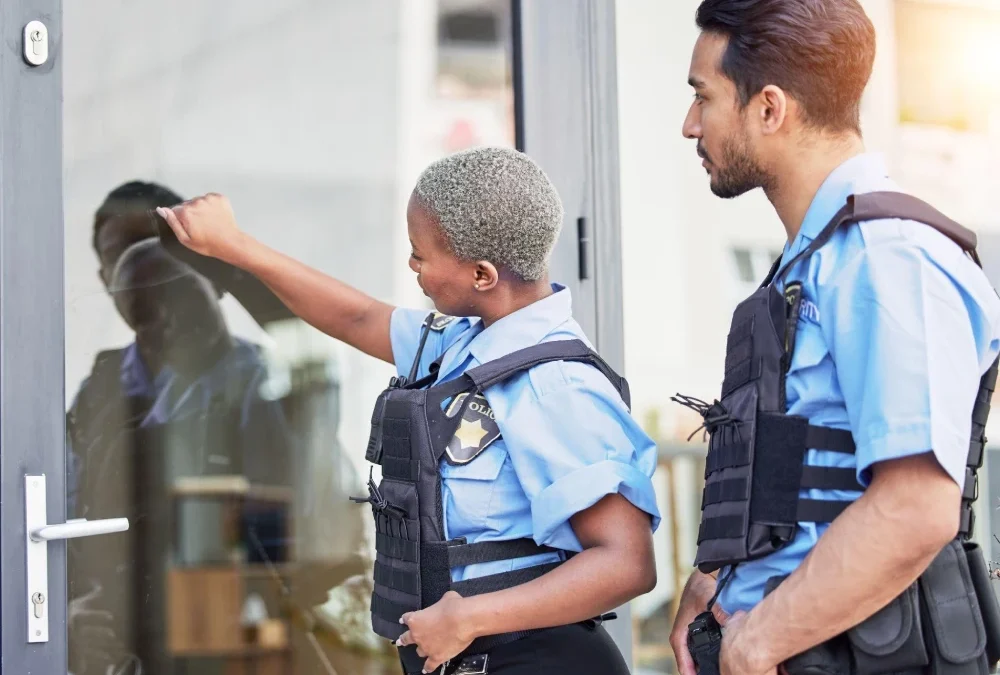
Introduction: Police at Your Door in North Las Vegas—A Guide for Residents
This guide is for North Las Vegas residents concerned about police visits to their home. Police at your door in North Las Vegas is a situation that can happen to anyone, and knowing what to do is crucial. It covers your rights, what to do if police knock, and common legal pitfalls that can jeopardize your case. Understanding these rights can prevent legal mistakes and protect your freedom. Whether you’re a homeowner, renter, or just visiting, this article will help you navigate police encounters at your front door with confidence.
Search and seizure law is at the heart of your constitutional rights as a homeowner or resident in Nevada. The Fourth Amendment of the United States Constitution protects you from unreasonable searches and seizures, meaning law enforcement officers cannot simply enter your home or take your property without following strict legal procedures. In most cases, a valid search warrant—signed by a judge and based on solid evidence—is generally required before police can conduct a search or seize evidence from your home.
However, there are exceptions, such as exigent circumstances, where immediate action is necessary to prevent harm or the destruction of evidence. Nevada’s search and seizure laws are designed to strike a balance between your right to privacy and the need for law enforcement to gather evidence in criminal investigations. Understanding these laws empowers you to recognize when your constitutional rights are at risk and when law enforcement must have a valid search warrant or meet specific legal standards to enter your property. Knowing your rights under the Fourth Amendment and Nevada’s seizure law is the first step in protecting yourself from unreasonable searches and seizures.
Most Common Reasons Police May Come to Your Door in North Las Vegas
Police may visit homes in North Las Vegas for several reasons, including:
- Community Engagement: Officers may stop by to build relationships or provide information as part of neighborhood policing.
- Welfare Checks: Officers are often dispatched for welfare checks due to concerns from family, friends, or neighbors about a resident’s safety.
- Investigations: Police may visit to ask questions or gather information related to ongoing investigations.
- Serving Legal Documents: Officers may deliver subpoenas, summons, or other legal paperwork.
- 911 Hang-Up Calls: Officers may arrive at a location after a 911 hang-up call to verify there is no emergency.
- Domestic Disturbances: Police respond to domestic disturbances as required by Nevada law to ensure safety.
- Search Warrants: Officers may visit homes to serve search warrants if there is probable cause of criminal evidence.
Knowing why police might be at your door can help you respond appropriately and protect your rights.
Key Takeaways
Key Takeaways: Survival Guide for Police Encounters
- The Door is a Barrier: You are not legally required to open the door unless the police have a warrant signed by a judge.
- Consent is Permanent: Once you say “come in,” you usually can’t take it back easily. Most searches happen because people say “okay” just to be nice.
- The “Plain View” Trap: If you open the door even an inch, and the police see something illegal on your coffee table, they no longer need a warrant.
- Exigent Circumstances: Police can only rush in if there is an active emergency (like a fire or a scream for help) or “Hot Pursuit.”
- Silence is Golden: You don’t have to explain why you aren’t opening the door. “I do not consent to a search or entry” is all you need to say.
Introduction to Search and Seizure Laws
Search and seizure law is central to your constitutional protections as a resident of Nevada. The Fourth Amendment of the United States Constitution shields you from unreasonable searches and seizures. This means law enforcement cannot enter your home or seize your property without following strict legal procedures.
In most cases, police need a valid search warrant—signed by a judge and based on solid evidence—before they can search your home or take your property. There are exceptions, such as exigent circumstances, where immediate action is necessary to prevent harm or destruction of evidence.
Nevada’s search and seizure laws aim to balance your right to privacy with law enforcement’s need to investigate crimes. Understanding these laws empowers you to recognize when your rights are at risk and when police must have a valid warrant or meet specific legal standards to enter your property.
What Should I Do If the Police Are at My Door in North Las Vegas?
It’s a sound that makes anyone’s heart race—a loud, rhythmic knocking at the door followed by the shout: “Police! Open up!” Whether it’s 2 PM or 2 AM, your first instinct might be to pull the door open and ask what’s wrong. But in that split second, you are standing on a legal cliff.
I’m Attorney Michael Gowdey. For over 30 years, I’ve been defending the accused at The Law Offices of Michael I. Gowdey, Ltd. Our firm has extensive experience handling search and seizure cases, with experienced attorneys who are well-versed in defending clients’ constitutional rights against unlawful police actions. We’ve won awards for our work in Criminal Defense and Family Law, but the most important work I do is teaching people how to protect themselves before the handcuffs come out.
In Nevada, your home is your castle. The Fourth Amendment of the U.S. Constitution and Article 1, Section 18 of the Nevada Constitution give you a shield. But that shield only works if you don’t accidentally throw it away.
What to Do When Police Knock: Step-by-Step
- You are not legally required to open your door for police unless they have a warrant.
- Use a peephole or doorbell camera to identify officers before opening the door.
- You can talk to officers through a closed door if you choose not to open it completely.
- Officers must identify themselves and provide the reason for their visit.
- If you are unsure about the legitimacy of the visit, you can contact the local police department to verify.
Staying calm and following these steps can help you avoid common legal pitfalls and protect your rights.
Understanding Probable Cause
Probable cause is the legal backbone of any search and seizure conducted by law enforcement officers. It means that police must have a reasonable basis—more than just a hunch or mere suspicion—to believe that a crime has occurred or that evidence of criminal activity will be found in the place they want to search.
In Nevada, a search warrant cannot be issued unless law enforcement presents factual information to a judge showing probable cause. If police conduct a search or seize property without probable cause, any evidence obtained may be challenged in court and potentially excluded from your criminal case.
This is why it’s crucial to have an experienced criminal defense attorney review the circumstances of your search and seizure. A strong defense strategy often involves scrutinizing whether law enforcement officers had a reasonable basis for their actions. If the court finds that probable cause was lacking, the evidence—and sometimes the entire case—can be thrown out.
Now that you understand probable cause, let’s look at when police can enter your home without a warrant.
Can Nevada Police Enter My Home Without a Search Warrant?
The short answer is: Usually, no. But “usually” is a big word in the legal world. In North Las Vegas and the rest of Clark County, officers must follow the rules of “Search and Seizure.”
Police are legally restricted to searching only the places authorized by a valid search warrant; they cannot search beyond only the places specified in the warrant. If police conduct a search under an invalid warrant, any evidence obtained may be excluded from court.
The Stats Nobody Talks About
Here is something that might shock you: While we hear about “no-knock” warrants on TV, the vast majority of police entries in Nevada are actually consent searches.
- According to data from various justice studies, nearly 90% of searches conducted by police are done with “consent” rather than a warrant (Source: Bureau of Justice Statistics).
- In the Las Vegas Valley, where tourism and transient populations are high, police often rely on “knocking and talking” to get people to voluntarily give up their rights.
The term “Knock and Talk” refers to officers visiting a home without a warrant to gather information.
The Geographic Reality: North Las Vegas vs. The Strip
In 2024, North Las Vegas saw a specific focus on “community policing.” While this sounds friendly, it often means more officers are walking neighborhoods and knocking on doors. Geographically, Clark County handles more than 70% of Nevada’s total court cases. This means the judges are busy and the police are often looking for the “fastest” way into a home—which is getting you to say “Yes.”
Transitioning from when police can enter your home, let’s examine the specific legal exceptions to the warrant requirement.
What Are the 4 Major Exceptions to the Warrant Requirement in NV?
If the police don’t have a piece of paper signed by a judge, they can only cross your doorway in four specific “emergency” situations. These are called “Warrant Exceptions.”
A warrantless search or warrantless seizure is only permitted under specific legal exceptions, and exigent circumstances must independently justify such actions beyond other justifications.
1. Consent (The Mistake You Must Avoid)
If you open the door and say, “Sure, come in and look around,” you just gave up your Fourth Amendment rights. In Nevada, consent must be voluntary. If they threaten to “kick the door down” unless you let them in, that might not be voluntary—but it’s much harder to prove that in court later.
2. Plain View
If you open the door to talk to an officer and they see a bag of illegal substances or a weapon on your kitchen counter, the “Plain View Doctrine” kicks in. Since the evidence is visible from where the officer is legally allowed to stand (your porch), they can now enter and arrest you. If police find drugs in plain view, they may use that as justification for entry and arrest; however, the legality of the search and seizure can still be challenged in court if proper procedures were not followed, and any evidence found could potentially be excluded.
3. Exigent Circumstances (Life or Death)
Police can enter if they reasonably believe someone inside is being hurt, there is a fire, or someone is destroying evidence (like flushing something down the toilet). In 2024, Clark County emergency calls for “domestic disturbance” were a leading cause for these types of entries.
4. Hot Pursuit
If the police are chasing a suspect and that person runs into your house, the police don’t have to stop at the door and call a judge. They can follow the suspect inside to make the arrest.
Understanding these exceptions is crucial for knowing when your rights apply and when police may lawfully enter without a warrant. Next, let’s discuss what happens if police overstep these boundaries.
Police Searches and the Exclusionary Rule
The exclusionary rule is a powerful protection for anyone whose Fourth Amendment rights have been violated by an illegal search or seizure. If law enforcement officers conduct a search without a valid warrant, without probable cause, or outside the boundaries of the law, any evidence obtained through that illegal search may be excluded from court. This means the prosecution cannot use that evidence against you, which can significantly weaken or even lead to the dismissal of criminal charges.
In Nevada, the exclusionary rule is strictly enforced to ensure that law enforcement respects constitutional rights and follows proper procedures when they conduct searches. An experienced criminal defense attorney can file a motion to suppress evidence obtained in violation of your Fourth Amendment rights, forcing the court to consider whether the search was lawful. This rule not only protects individuals from government intrusions but also encourages police to gather evidence legally and ethically.
If you believe your rights were violated during a search, seeking legal counsel immediately can make all the difference in the outcome of your case.
Now, let’s address some of the most common questions residents have about police at their door in Las Vegas.
The “Step Outside” Trick: Why You Should Stay Put
Often, an officer will say, “Hey, can you just step outside so we can talk for a second?” Don’t do it. When you are inside your home, you have the highest level of protection. The second you step onto the sidewalk or even your driveway, your legal protections drop. It is much easier for the police to arrest you or search your pockets once you have left your “castle.”
Stay inside. Speak through the door. If you must see a warrant, ask them to hold it up to the window or slide it under the door.
Frequently Asked Questions
Identification and Entry
1. Do I have to show ID to police at my door in Nevada?
- Generally, no. Nevada has a “Stop and Identify” law (NRS 171.123), but it usually applies to people in public places when an officer has “reasonable suspicion.” Inside your home, you don’t have to show ID just because they knocked.
2. Can police enter if my roommate says “okay” but I say “no”?
- This is tricky. Usually, if two people live there and one says “yes” while the other is standing right there saying “no,” the police cannot enter. But if you aren’t home and your roommate gives permission, the search is likely legal.
3. What if the police say they smell marijuana?
- In Nevada, marijuana is legal for adults. However, “public consumption” is still a crime. If they smell it and think you are selling it or have an illegal amount, they might try to use that as “probable cause,” but it is much harder for them than it used to be.
4. Can they break my door down?
- Only if they have a “No-Knock” warrant or an active emergency. If they break your door without a legal reason, any evidence found during an unlawful entry may be excluded from the prosecution’s case if the court agrees that your rights were violated.
5. Should I record the interaction?
- In Nevada, you have a right to record police as long as you aren’t interfering with their work. Your phone is your best witness. Police generally need a warrant to search your cell phone, and recent court rulings have strengthened digital privacy protections.
Warrants and Consent
6. What if they have a warrant but the address is wrong?
- Stay calm. Point out the mistake, but do not physically fight them. If the warrant is invalid, Nevada courts may suppress any evidence obtained, leading to favorable outcomes for your case. We will handle the “wrongful entry” in court later.
7. Can my landlord let the police into my apartment?
- Your landlord cannot give consent to search your private home. Only a resident can do that.
8. What if I am on probation or parole?
- If you are on supervision, you likely signed a “4th Amendment Waiver.” This means you did give up your right to refuse a search as part of your deal to stay out of jail. However, searches must still be related to a lawful arrest or officer safety, and only the relevant evidence can be used in court.
Special Situations
9. Can police look through my trash?
- In Nevada, once your trash is at the curb, it is considered “abandoned.” Police can look through it without a warrant. Keep sensitive things shredded!
10. Why should I hire Michael Gowdey?
- Because we know the North Las Vegas and Henderson police departments. We know when they follow the rules and when they cut corners. With 30 years of experience, we have a thorough understanding of the legal system, experience with Nevada courts, and the ability to challenge evidence based on the following circumstances, such as the need for a new warrant or improper procedures. We know how to get illegal evidence thrown out so your case gets dismissed.
Conclusion: Your Silence is Your Strength
The police are trained to get you to talk. They are trained to make you feel like you have to cooperate. But the law says otherwise. At The Law Offices of Michael I. Gowdey, Ltd., we’ve spent three decades protecting the accused in Las Vegas. We offer a free consultation to discuss your specific situation and legal options. Whether it’s a Criminal Defense matter or a complicated Family Law case, we are the shield between you and the state.
Don’t make the mistake of being “too nice” to the police. Be polite, stay calm, and stay behind your door.
👉 Click here to schedule a consultation with Attorney Michael Gowdey
⚖️ Disclaimer: This article provides legal information, not legal advice. Every situation is different. To protect your home and your freedom, talk to an attorney at our firm about your specific situation.