
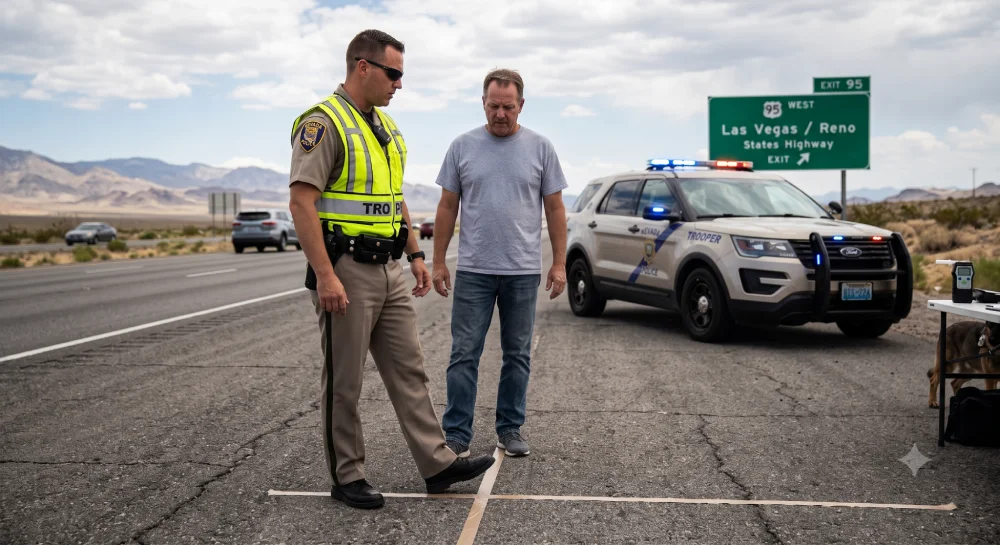
Getting pulled over on the Las Vegas Strip or a Henderson highway under suspicion of driving under the influence is a terrifying experience. Flashing red and blue lights in your rearview mirror can make your heart race. As the police officer walks up to your window, your mind floods with questions about your rights, your future, and your freedom.
When an officer suspects a driver has been drinking, they almost always ask them to step out of the car to perform a series of physical movements. Most people comply because they assume they have no choice. With more than 30 years of trial experience defending citizens in Clark County courts, I see drivers make this mistake every single day. You need to know the reality of Nevada traffic laws before you make a decision that could hurt your defense.
Key Takeaways
- Field Sobriety Tests Are Voluntary: You are not legally required to perform physical roadside agility tests in Nevada. You can politely say no.
- Roadside Tests Are Designed For Failure: These exercises are highly subjective. The officer decides if you pass or fail based on minor slip-ups.
- Implied Consent Applies After Arrest: Roadside exercises are entirely different from the formal breath or blood tests required after a lawful DUI arrest.
- Refusal May Still Lead to Arrest: Declining the physical tests keeps evidence away from the state, but the officer can still arrest you using other observations.
Do You Legally Have to Take Field Sobriety Tests in Nevada?
No, you do not legally have to take Standardized Field Sobriety Tests in Nevada. These physical exercises are completely voluntary. You have the right to politely refuse to perform them, and you cannot face direct legal penalties or automatic driver’s license suspensions solely for saying no.
When the Las Vegas Metropolitan Police Department (Metro) or the Nevada State Police stop you, they will not tell you that these tests are optional. They will phrase their request as a direct command, like “Step out of the car and follow the tip of my pen.”
It is completely legal to stay calm and say, “I am choosing to decline these physical tests on the advice of my attorney.” By refusing, you stop the police from creating video and physical evidence that the Clark County District Attorney will later use to try to convict you in court.
What Are the Three Standardized Field Sobriety Tests?
The three National Highway Traffic Safety Administration (NHTSA) approved roadside tests are the Horizontal Gaze Nystagmus (eye test), the Walk-and-Turn, and the One-Leg Stand. Officers use these physical and cognitive exercises to find signs of impairment and build probable cause for a DUI arrest.
Every standard DUI investigation in Clark County relies on this specific trio of exercises. Here is what they actually look for:
1. Horizontal Gaze Nystagmus (HGN)
The officer holds a small flashlight or pen about 12 inches from your face. They move it side-to-side and watch your pupils. They look for an involuntary jerking of the eyeball. Even if you feel completely sober, medical issues, prescription drugs, or simple fatigue can make your eyes jerk, which the officer logs as a failure.
2. The Walk-and-Turn Test
This is a “divided attention” test. You must walk nine steps down a straight line, heel-to-toe, turn around in a specific way, and walk nine steps back. The officer looks for eight specific clues, including losing your balance, starting before the instructions are done, or taking the wrong number of steps.
3. The One-Leg Stand Test
You must lift one foot six inches off the ground, lock your knees, look at your foot, and count out loud until told to stop. If you sway, hop, use your arms for balance, or put your foot down just once, the officer marks it down as a sign of intoxication.
What Is the Difference Between Roadside Tests and Chemical Tests?
The primary difference is that physical field sobriety tests are completely voluntary, while evidentiary chemical tests (blood or breath tests) taken after a formal DUI arrest are mandatory under Nevada’s Implied Consent Law found in NRS 484C.160.
It is very common to confuse roadside tests with the chemical tests that happen later. This distinction is the most important part of Nevada DUI law.
| Test Type | When It Happens | Is It Legally Mandatory? | Penalty for Refusal |
| Field Sobriety Tests (Physical exercises) | Roadside, before an arrest | No. Completely voluntary. | None. No automatic penalties. |
| Preliminary Breath Test (Roadside PBT device) | Roadside, before an arrest | No. Voluntary. | No license suspension, but can be used to justify an arrest. |
| Evidentiary Chemical Test (Post-arrest breath or blood) | At the police station, CCDC jail, or hospital | Yes. Mandatory under Implied Consent (NRS 484C.160). | Automatic 1-year driver’s license revocation; police will get a warrant to draw blood by force. |
If you drive on any public road in Las Vegas, Henderson, or North Las Vegas, you have already given your implied consent to take a chemical test if you are lawfully arrested for a DUI. If you refuse the chemical test at the station, the police will call a judge, get a telephonic search warrant, and use reasonable physical force to take your blood sample anyway.
What Common Mistakes Should I Avoid During a Las Vegas DUI Stop?
Avoiding critical mistakes during the initial traffic stop can keep a bad situation from turning into a permanent criminal record.
- Do Not Give Long Explanations: You must show your driver’s license, registration, and proof of insurance. Beyond that, you do not have to answer questions like “Have you been drinking tonight?” or “Where are you coming from?” Anything you say will be typed into the police report.
- Do Not Assume You Will Pass Because You Feel Fine: These tests are highly subjective. They are performed on uneven asphalt, in the dark, next to rushing highway traffic, under extreme stress. Perfect performance is nearly impossible.
- Do Not Argue or Fight with the Officer: If you decide to refuse the voluntary physical tests, do it politely. Being aggressive gives the prosecutor a reason to argue you were acting unruly due to alcohol.
What to Do in the First 24 Hours After a DUI Arrest
If the police do place you under arrest and transport you to the Clark County Detention Center (CCDC) or the City of Las Vegas Jail, the clock starts ticking immediately on your defense.
- Write Down Every Detail: As soon as you are released, write down everything you remember. Note the weather conditions, the location of the stop, whether the ground was rocky or uneven, and how the officer behaved.
- Do Not Post on Social Media: Never post about your arrest, your night out, or your case on any social platform. Investigators routinely search public accounts for evidence.
- Request a DMV Hearing Within 7 Days: If the police took your license, you only have seven days from the date of your arrest to request an administrative hearing with the Nevada Department of Motor Vehicles (DMV). If you miss this deadline, your driving privileges will be automatically suspended.
- Contact an Experienced Trial Attorney: A DUI charge involves two separate battles: one with the Nevada DMV to keep your license, and one in the Clark County District Court or local municipal courts to protect your freedom. You need an advocate who knows how to navigate both systems.
Frequently Asked Questions
Can the police arrest me if I refuse the field sobriety tests?
Yes, the police can still arrest you if you refuse the tests. They will use other observations to establish probable cause, such as the smell of alcohol, slurred speech, bloodshot eyes, or erratic driving behavior observed before the stop.
Will my refusal to take roadside tests be used against me in court?
While prosecutors may try to argue that you refused because you knew you were impaired, an experienced defense attorney can show the court that you simply chose to exercise your constitutional right to avoid an unreliable, subjective test.
What happens if I have a medical condition that affects my balance?
Physical conditions like back injuries, knee problems, inner ear issues, or obesity make it incredibly difficult to pass the Walk-and-Turn or One-Leg Stand. If you did take the tests, my team can use your medical records to show the court that your poor performance was due to physical limitations, not alcohol.
Can a police officer force me to blow into a portable breathalyzer on the side of the road?
No. The small, handheld breath tester used on the side of the road is called a Preliminary Breath Test (PBT). Like physical agility tests, it is voluntary. The results of a PBT cannot even be used as direct evidence of guilt at your trial; they are only used by police to decide whether to arrest you.
How many DUI arrests happen in Clark County each year?
DUI enforcement is an absolute priority for local law enforcement. According to recent local safety data, [Insert accurate Clark County statistic here], making it one of the most heavily prosecuted crimes in the Las Vegas valley.
Can a first-time DUI charge in Las Vegas be reduced?
Yes. Depending on the details of your traffic stop, whether your constitutional rights were respected, and the chemical test results, it is possible to negotiate a DUI down to a lesser charge like reckless driving. You can learn more about our specific defense methods on our [Internal Link: Las Vegas DUI Defense page].
Put an Experienced Las Vegas Trial Attorney on Your Side
A DUI arrest does not mean you are automatically guilty. Police officers must follow strict legal procedures during a traffic stop, and when they cut corners or misinterpret performance on voluntary tests, the state’s case begins to fall apart.
With over 30 years of courtroom experience in Southern Nevada, I know how to audit police footage, challenge chemical testing accuracy under [Insert link to NV .gov source], and fight aggressively to defend your rights and your driver’s license.
If you are facing a DUI charge in Clark County, contact The Law Offices of Michael I. Gowdey, LTD. today