
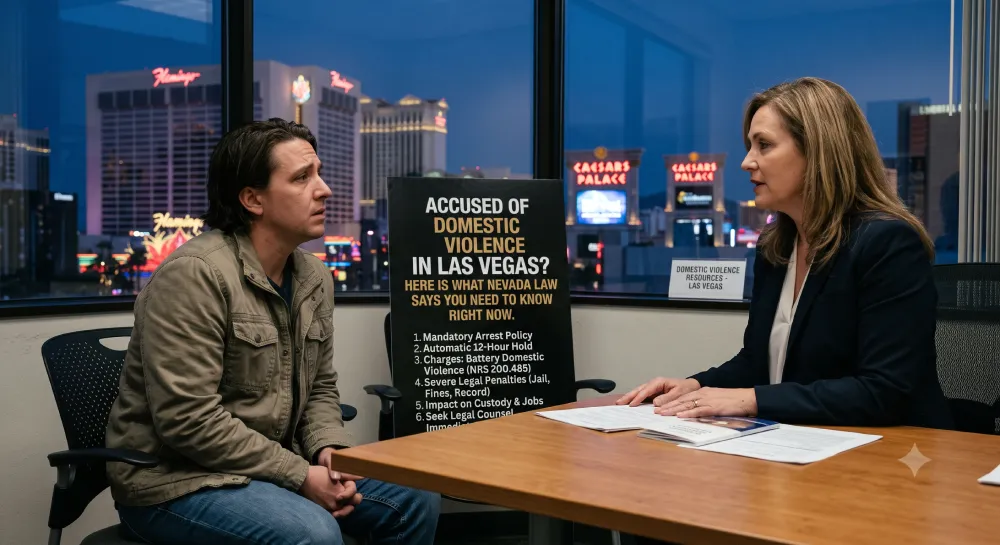
Key Takeaways — Read These Before You Do Anything Else
- Nevada has a mandatory arrest law for domestic violence. If police respond to a DV call and see any sign of injury, they must make an arrest — even if both parties say nothing happened.
- The alleged victim cannot simply drop the charges. In Nevada, the State — not the victim — prosecutes domestic violence cases. A victim recanting does not automatically end the case.
- A first-offense battery domestic violence conviction in Nevada carries up to 6 months in jail, fines, mandatory counseling, and a federally imposed lifetime ban on firearm possession.
- Clark County processes more domestic violence cases per year than any other county in Nevada — with over 23,000 DV incidents reported in Las Vegas Metro jurisdiction in a single recent year.
- Studies show that between 2% and 10% of domestic violence accusations are false — but in high-conflict divorce or custody situations, some researchers estimate that number climbs significantly higher.
- A DV conviction cannot be sealed in Nevada for 7 years — and affects employment, housing, professional licenses, custody, and immigration status.
- A protective order can be issued within hours of arrest, removing you from your home before you have had a chance to speak with any attorney.
- Attorney Michael I. Gowdey has defended domestic violence cases in Las Vegas, Henderson, and North Las Vegas for over 30 years. Call before you say anything to law enforcement.
It happens fast. One phone call to 911. Officers show up. Words get exchanged. And before the night is over, you are sitting in the Clark County Detention Center while someone else is sleeping in your house.
You may not have touched anyone. You may have been the one who was actually hurt. You may be dealing with a false accusation from a spouse in the middle of a bitter divorce, an ex who is trying to gain an edge in a custody fight, or a situation that got blown wildly out of proportion.
None of that changes what happened the moment those handcuffs went on. And unless you understand how Nevada’s domestic violence laws actually work — and unless you have a lawyer who knows how to fight these charges — that arrest can turn into a conviction that follows you for the rest of your life.
At The Law Offices of Michael I. Gowdey, we have been defending people in exactly this situation for more than three decades. We do not judge. We do not assume guilt. We look at the facts, we challenge what needs to be challenged, and we fight for the outcome you deserve.
Let us walk through what you are actually dealing with — and what can realistically be done about it.
23,000+
DV incidents reported in LVMPD jurisdiction in a single recent year (LVMPD Annual Report)
#1
Clark County leads all Nevada counties in domestic violence case filings annually
Mandatory
Nevada requires arrest on DV calls when probable cause exists — no officer discretion
7 Years
Waiting period to seal a first battery DV conviction in Nevada (NRS 179.245)
What Counts as Domestic Violence Under Nevada Law?
Most people think domestic violence means a husband hitting a wife. Under Nevada law, it is a lot broader than that — and that matters enormously when someone gets accused.
Under Nevada Revised Statute 33.018, domestic violence includes any of the following acts committed against a protected person:
- Battery (any willful and unlawful use of force or violence against another person)
- Assault (an intentional attempt or threat to commit battery)
- Stalking or harassment
- Arson
- Trespassing
- Larceny or destruction of private property
- Unlawful entry into a home
- Compelling or attempting to compel a person to engage in conduct from which they have a right to abstain
- Sexual assault
- Kidnapping or false imprisonment
- Any act that constitutes a threat or use of physical force against another person
Notice that battery — which is the most common DV charge — does not require a visible injury. Under Nevada law, any willful and unlawful use of force or violence, no matter how minor, qualifies. That means a shove. A grab. Even blocking someone’s path can be charged depending on how it is described to police.
And here is the part that really matters about who is considered a “protected person” under the statute:
- A current or former spouse
- A person with whom you share a child
- Any person you are currently dating or have dated
- A relative by blood or marriage
- A current or former roommate
- A guardian or ward
That is a wide net. It covers exes you split from years ago. It covers roommates you barely know. It covers family arguments at Thanksgiving. And it means that the domestic violence statute applies to a much larger share of the population than most people realize — until they find themselves on the wrong end of it.
A Clark County Reality Check
According to the Las Vegas Metropolitan Police Department, domestic violence is consistently one of the top three call types responded to by officers in Clark County. The LVMPD’s Family Protection Division handles thousands of cases per year — and the department operates under a pro-arrest policy that removes officer discretion when physical evidence of a crime is present.
What Happens if the Alleged Victim Recants or Doesn’t Want to Press Charges?
This is probably the single most misunderstood aspect of domestic violence law in Nevada. It is also the question we hear most often when someone calls our office the morning after an arrest.
Here is the answer that surprises almost everyone: it does not matter what the alleged victim wants.
In Nevada, domestic violence cases are prosecuted by the State — meaning the Clark County District Attorney’s office or the Henderson or North Las Vegas city prosecutors, depending on where the incident occurred. The victim is a witness in a state-initiated prosecution, not the person deciding whether to press charges.
Once a DV call is made and an arrest occurs, the State takes over. The victim can tell prosecutors they do not want to proceed. They can refuse to cooperate. They can even tell the court they fabricated the accusation. None of that automatically ends the case.
Prosecutors in Clark County are trained to build DV cases without cooperative victims. They use:
- 911 call recordings (often the most powerful evidence in a DV case)
- Body camera footage from responding officers
- Photos of any injuries or property damage taken at the scene
- Statements the alleged victim made to police before they recanted
- Neighbor or bystander witness statements
- Hospital or medical records
- Prior incident reports at the same address
- Text messages or social media exchanges between the parties
The “****No Drop****”** Policy in Clark County**
The Clark County District Attorney’s office maintains what is effectively a “no drop” policy on domestic violence cases — meaning prosecutors will not simply dismiss a DV charge just because the complaining witness asks them to. Prosecutors are particularly resistant to dropping charges when physical evidence of injury exists, prior incidents are on record, or children were present during the alleged incident.
This is why the strategy in a domestic violence case almost never comes down to convincing the alleged victim to change their story. An experienced defense attorney approaches these cases by attacking the physical evidence, challenging the credibility of prior statements, cross-examining officers on their observations, and building a narrative that creates reasonable doubt — all before or during trial.
“People call me and say, ‘She already told the DA she doesn’t want to do this anymore.’ And I have to explain to them that the DA does not work for her — the DA works for the State of Nevada. That is a painful conversation, but it is an essential one. We need to start building the defense immediately, not wait and hope the case falls apart on its own.”
— Attorney Michael I. Gowdey
Can a Domestic Violence Charge Be Dropped in Nevada?
Yes — charges can be reduced or dismissed in Nevada domestic violence cases. But it takes work, strategy, and an attorney who understands how the Clark County system actually operates.
Here are the most common pathways to a dismissal or reduction:
Lack of Sufficient Evidence
If the prosecutor cannot prove every element of the charge beyond a reasonable doubt, the case should not proceed. An experienced defense attorney files pre-trial motions to challenge evidence, suppress illegally obtained statements, and expose weaknesses in the State’s case. When prosecutors realize they cannot prove their case, dismissals happen.
Self-Defense
Nevada law (NRS 200.200) recognizes the right to self-defense. If you used force to protect yourself from an attack, you may have a legitimate self-defense claim — even in a domestic situation. This is especially relevant in cases where the alleged victim was actually the primary aggressor and you were defending yourself.
Challenging the Alleged Victim’s Credibility
If the alleged victim has a history of false reports, a motive to fabricate (such as a pending divorce or custody dispute), or has given inconsistent statements, that inconsistency can be powerful at trial. Prosecutors know when their witness has credibility problems.
Diversion Programs
For eligible first-time offenders, Clark County does offer limited domestic violence diversion options that can result in a charge being dismissed upon completion of counseling and other requirements. Not everyone qualifies, and the availability of diversion varies. An attorney needs to evaluate whether this path is in your interest before you agree to any program.
Negotiated Reduction
In many cases, a skilled defense attorney can negotiate a battery domestic violence charge down to a simple battery or disorderly conduct — charges that do not carry the lifetime federal firearms ban, the 7-year sealing wait, or the same professional and immigration consequences as a DV conviction.
Why This Distinction Matters Enormously
The difference between a conviction for “battery domestic violence” and “simple battery” is not just a label. A battery DV conviction triggers mandatory federal consequences under the Lautenberg Amendment (18 U.S.C. § 922(g)(9)) — including a lifetime ban on firearm possession that applies to private citizens, hunters, veterans, and even law enforcement officers. A simple battery conviction does not carry those federal consequences.
Do Not Talk to Police or Prosecutors Without an Attorney
Anything you say after a domestic violence arrest can be used to build the State’s case against you. Attorney Gowdey has over 30 years of experience defending DV cases in Clark County courts. Call immediately — before your first court appearance.
Call for a Free Consultation Criminal Defense Overview
What Is the Penalty for Battery Domestic Violence in Nevada?
The penalties for battery domestic violence in Nevada escalate significantly with each conviction. And unlike many other criminal charges, the federal consequences that attach to even a first-time conviction make this one of the most consequential misdemeanors in the entire U.S. criminal code.
| Offense Level | Classification | Jail / Prison | Fines | Additional Requirements |
|---|---|---|---|---|
| 1st Offense BDV (within 7 years) | Misdemeanor | 2 days – 6 months | $200 – $1,000 | DV counseling (weekly, 1–2 years), community service, federal gun ban |
| 2nd Offense BDV (within 7 years) | Misdemeanor | 10 days – 6 months | $500 – $1,000 | Mandatory counseling, longer community service, federal gun ban |
| 3rd or Subsequent (within 7 years) | Category C Felony | 1 – 5 years (state prison) | Up to $10,000 | Felony record, mandatory counseling, federal gun ban |
| BDV with Strangulation | Category C Felony | 1 – 5 years (state prison) | Up to $10,000 | Elevated charge regardless of prior record |
| BDV Causing Substantial Bodily Harm | Category B Felony | 2 – 15 years (state prison) | Up to $10,000 | Cannot be sealed; most serious DV charge |
Beyond what that table shows, a battery domestic violence conviction carries a cascade of collateral consequences that the court never reads aloud at sentencing:
- Federal lifetime firearms ban under the Lautenberg Amendment — applies to misdemeanor DV convictions, not just felonies
- Cannot seal the conviction for 7 years under NRS 179.245
- Professional license consequences — nursing boards, teaching licenses, security guard licenses, and gaming licenses in Nevada are all affected
- Immigration consequences — a DV conviction is considered a “crime of moral turpitude” under federal immigration law and can result in deportation or denial of naturalization for non-citizens
- Child custody impacts — Nevada family courts treat DV convictions as significant negative factors in custody determinations
- Housing and employment — background checks will show the conviction for 7 years minimum
- Gaming industry employment — one of Nevada’s largest employment sectors, gaming regulators scrutinize DV records during licensing reviews
The Firearms Consequence Nobody Warns You About
The federal Lautenberg Amendment (18 U.S.C. § 922(g)(9)) permanently prohibits anyone convicted of a misdemeanor crime of domestic violence from possessing a firearm or ammunition. This is a federal law. It cannot be undone by a Nevada pardon, a Nevada record seal, or any state-level remedy. It applies to hunters, veterans, concealed carry permit holders, and law enforcement officers. Thousands of people plead guilty to misdemeanor BDV every year not understanding they are permanently surrendering a constitutional right.
How Do False Domestic Violence Accusations Affect a Case?
False accusations of domestic violence happen more than most people want to admit. And in Las Vegas and Clark County — where divorce rates are high, custody battles are fierce, and some people understand that a DV accusation can dramatically shift the balance of power in a family law proceeding — the stakes around false allegations are very real.
Here is what the research actually shows:
What the Research Says on False DV Accusations
A peer-reviewed study published in the Journal of Family Violence found that false accusation rates in domestic violence cases range from approximately 2% to 10% in general populations — but that in cases involving contested child custody, the rate of unsubstantiated allegations climbs significantly higher. A study published in BMJ found that in high-conflict custody disputes, allegations of abuse — including domestic violence — were unsubstantiated in a substantial minority of cases. The Office of Justice Programs has also noted the challenges prosecutors face when complaining witnesses later recant or give inconsistent statements — which happens in a significant percentage of DV prosecutions.
A false accusation does not mean your case is automatically winnable. In fact, the mandatory arrest law means you have already been arrested and are already facing charges. The challenge is now proving to a prosecutor or jury why the accusation should not be believed.
How We Defend False Domestic Violence Accusations
Over three decades of handling these cases, Attorney Gowdey has developed an approach to false allegation cases that goes well beyond just saying the accuser is lying:
We document the motive. If the alleged victim stands to benefit from the accusation — through a better position in divorce proceedings, by gaining sole custody of children, or by securing a protective order that removes you from the family home — that motive is documented and presented.
We gather your own evidence. Text messages, emails, social media posts, surveillance footage, witness statements from people who were present, and your own account of events are all part of building the counter-narrative.
We analyze inconsistencies. Did the alleged victim give a different account to the 911 operator than they gave to the responding officer? Did their statement change between the initial report and a follow-up interview? Those inconsistencies are not minor details — they are the foundation of a credibility challenge.
We look at the physical evidence critically. Alleged injuries that are inconsistent with the accused’s account, injuries that could have been self-inflicted, or a complete absence of physical evidence in a case with claims of serious violence — all of these are relevant to the defense.
We address the protective order. A temporary protective order (TPO) can be issued in Nevada without you being present or having a chance to respond. We file immediately to schedule a hearing and challenge the TPO on the merits before it becomes a permanent order.
Domestic Violence in Clark County — The Numbers Behind the Cases
Las Vegas is a complicated city. The same energy that makes it one of the most exciting places in the world also creates conditions where personal relationships come under unique pressures — long hours in the service industry, alcohol and gaming culture, financial stress, and a transient population that sometimes lacks the extended family support networks found in other cities.
~30%
of all violent crime arrests in Clark County involve domestic violence (Nevada Coalition to End DV)
60%
of DV cases in Clark County involve alcohol at the time of the alleged incident (LVMPD data)
1 in 4
Women and 1 in 9 men in Nevada experience severe intimate partner violence (CDC, NISVS)
48 hrs
Typical window before a DV arrest is followed by a first court appearance in Clark County
The Nevada Coalition to End Domestic and Sexual Violence reports that Nevada has historically ranked among the top states nationally for domestic violence rates — a reality that shapes how aggressively Clark County prosecutors pursue these cases and how seriously courts take protective orders.
The most common types of domestic violence cases filed in Las Vegas Justice Court and Clark County District Court include:
- Battery domestic violence — the single most common DV charge, ranging from simple physical contact to serious assault
- DV with strangulation — automatically elevated to a Category C felony in Nevada regardless of whether the victim has visible injuries
- Violation of a protective order — a separate criminal charge that can be filed even if the underlying DV charge is later dismissed
- DV stalking and harassment — increasingly common cases involving digital communication and social media conduct
- DV with a minor present — presence of a child under 18 at the time of an alleged DV incident can elevate sentencing exposure
According to data from the Nevada Judiciary Annual Report, DV-related cases consistently represent a significant portion of the criminal docket in Clark County — and the pace of prosecution has accelerated in recent years as the county has added dedicated DV prosecutors and a specialized DV court docket.
What Happens to a Protective Order After a Domestic Violence Arrest in Nevada?
A protective order — sometimes called a restraining order — is often issued within hours of a domestic violence arrest in Nevada. This can happen through an emergency temporary protective order (ETPO) filed by police or the alleged victim, or through the court’s own motion after arraignment.
The consequences of a protective order are immediate and serious:
- You may be ordered out of your own home — even if your name is on the lease or mortgage
- You may be prohibited from any contact with your children pending a hearing
- You may be ordered to surrender any firearms in your possession
- A violation of the order — even accidental contact — is a separate criminal charge
Under Nevada law (NRS 33.080), a temporary protective order can be issued by a judge without you being present. You are entitled to a hearing — but you have to know to request one quickly and you need an attorney to argue it effectively.
Do Not Violate the Protective Order — Even If They Contact You
One of the most common mistakes people make after a DV arrest is responding when the alleged victim reaches out to them. Even if they text first. Even if they say it is okay to come home. Even if you have children together and they are asking about pickup. If a protective order is in place and you respond, you can be charged with a separate criminal offense — and that charge can be used to push for pretrial detention and to damage your credibility in the underlying DV case.
What Happens in the Las Vegas Courts After a Domestic Violence Arrest?
Most first-time DV arrests in the Las Vegas area go through the Las Vegas Justice Court, the Henderson Justice Court, or the North Las Vegas Justice Court depending on where the incident occurred. Felony DV cases are handled in the Clark County Eighth Judicial District Court.
Clark County has a dedicated domestic violence docket with judges and prosecutors who specialize in these cases. That specialization means the court system moves quickly and has seen every defense argument. It also means that an attorney who regularly practices in these courts — and who has relationships and credibility with the relevant prosecutors and judges — is genuinely more effective than one who does not.
1. Arrest and Booking
You are booked into the Clark County Detention Center or a local facility. A protective order may be issued as a condition of release. You should call an attorney before you make any statements to anyone.
2. Arraignment (Within 72 Hours)
You appear before a judge, the charges are formally read, and you enter a plea. This is when the court also addresses bail and any protective order. Your attorney can argue for release conditions that allow you to return home.
3. Protective Order Hearing
If a temporary protective order was issued, a hearing must be held within 45 days to determine whether a permanent order is warranted. This hearing is often more winnable than people expect — with the right attorney and the right evidence.
4. Discovery and Defense Investigation
Your attorney obtains all evidence the State plans to use — 911 recordings, police reports, body cam footage, medical records, and witness statements. This phase often reveals critical weaknesses in the prosecution’s case.
5. Pre-Trial Motions
Motions to suppress evidence, dismiss charges for insufficient probable cause, or exclude certain statements can significantly alter the landscape of your case before trial ever begins.
6. Plea Negotiations or Trial
Depending on the strength of the evidence and the specific facts of your case, your attorney will pursue negotiated resolution — including possible reduction to a non-DV charge — or will take the case to trial if that is in your best interest.
Why Does Having an Experienced Las Vegas Domestic Violence Lawyer Actually Change the Outcome?
Defending a domestic violence case in Clark County is not the same as defending one in a rural Nevada county, or in a state that does not have mandatory arrest laws, or with a prosecutor who does not specialize in these cases. The Las Vegas DV court system has its own rhythm, its own tendencies, and its own pressure points. Experience in this specific system matters enormously.
Attorney Michael I. Gowdey has appeared in Las Vegas Justice Court, Henderson Justice Court, North Las Vegas Justice Court, and the Clark County District Court on domestic violence cases for more than 30 years. That experience means he knows:
- Which arguments carry weight with Clark County DV prosecutors and which ones do not
- How to evaluate the credibility of a 911 recording and identify its weaknesses before prosecutors build a case around it
- When to push for diversion and when diversion is a bad deal that hurts the client’s long-term interests
- How to negotiate with the DA’s office when the goal is reducing a DV charge to a non-DV offense and preserving firearm rights
- How to present a self-defense narrative that a judge or jury in Clark County will actually find credible
- How false accusation cases intersect with pending family court proceedings and how to coordinate strategy across both courts
The firm’s practice spans criminal defense, family law, and personal injury — and that full-spectrum capability matters in domestic violence cases, where the criminal charge and the family court battle are often happening simultaneously and each affects the other.
“The clients who come to me after a DV arrest are often the most scared people I work with. Not because the charge is always the most serious one I handle — but because the stakes are so personal. Their home. Their kids. Their job. I take that seriously, and every case gets the full weight of thirty years of experience in these courts.”
— Attorney Michael I. Gowdey
Your Freedom, Your Family, and Your Future Are Worth Fighting For
The Law Offices of Michael I. Gowdey has defended domestic violence charges in Las Vegas, Henderson, North Las Vegas, and across Nevada for over 30 years. Multiple awards. A reputation built on results. Call today — the earlier you act, the more options you have.
Free Consultation — Call Now Visit Our Website
10 Most Common Questions Asked About Domestic Violence Charges in Nevada
1. Can I be arrested for domestic violence in Nevada if there are no visible injuries?
Yes. Under Nevada’s mandatory arrest law (NRS 171.137), officers responding to a domestic violence call must make an arrest if they have probable cause to believe a DV crime has occurred — even with no visible injuries. Battery under Nevada law requires only the willful use of force, not injury. A push, a grab, or even grabbing someone’s arm can legally constitute battery domestic violence.
2. What is a mandatory arrest in Nevada domestic violence cases?
Nevada is a mandatory arrest state for domestic violence under NRS 171.137. This means if police respond to a DV call and find probable cause that a battery occurred — even without a formal complaint from the alleged victim — they are legally required to make an arrest. Officers do not have discretion to simply separate the parties and leave. One person is going to jail.
3. Can my spouse or partner drop the charges against me in Nevada?
No. Domestic violence cases in Nevada are prosecuted by the State, not the victim. Once charges are filed, only the prosecutor can drop them. However, if the alleged victim recants, refuses to cooperate, or gives a credible account that contradicts the prosecution’s theory, this information can be used by a defense attorney to negotiate a reduction or dismissal.
4. Will a domestic violence conviction affect my right to own a firearm?
Yes — permanently. Under the federal Lautenberg Amendment (18 U.S.C. § 922(g)(9)), anyone convicted of a misdemeanor crime of domestic violence is permanently prohibited from possessing firearms or ammunition. This federal prohibition cannot be removed by a Nevada record seal or pardon. It applies to hunters, veterans, and even active law enforcement officers.
5. How does a domestic violence charge affect child custody in Nevada?
Under NRS 125C.0035, Nevada family courts must consider evidence of domestic violence when determining child custody. A DV conviction creates a presumption against awarding primary or joint custody to the convicted party. Even an arrest without conviction can influence a family court judge’s decisions during an ongoing custody proceeding. This is one of the most serious collateral consequences of a DV charge in Nevada.
6. What is a temporary protective order and how quickly can one be issued in Nevada?
A Temporary Protective Order (TPO) in Nevada can be issued by a judge within hours of a DV incident — often without the accused being present or having any opportunity to respond. The TPO can immediately bar you from your home, restrict contact with your children, and require you to surrender firearms. A hearing must be scheduled within 45 days to determine whether the order should become permanent. Having an attorney at that hearing is critical.
7. What happens if I violate a protective order in Nevada?
Violating a protective order in Nevada (NRS 33.100) is a separate criminal offense. A first violation is typically a misdemeanor with up to 6 months in jail. A second violation within 7 years is a gross misdemeanor. A third violation is a Category C felony with 1 to 5 years in state prison. Critically, even if the alleged victim invites the contact, you can still be charged for violating the order — the victim’s consent is not a defense.
8. Can a non-citizen be deported for a domestic violence conviction in Nevada?
Yes. Under federal immigration law (8 U.S.C. § 1227(a)(2)(E)), a domestic violence conviction is a deportable offense. This applies even to lawful permanent residents (green card holders). It can also affect applications for naturalization, visa renewals, and re-entry into the United States after international travel. Non-citizens facing DV charges should consult an immigration attorney in addition to a criminal defense attorney.
9. Is domestic violence treated differently in Henderson or North Las Vegas compared to Las Vegas?
Nevada’s domestic violence laws are statewide, so the same statutes apply in Henderson, North Las Vegas, and Las Vegas. However, each city’s municipal court and prosecutor’s office has its own policies, tendencies, and approach to these cases. The City of Henderson Attorney’s office and the North Las Vegas City Attorney’s office both prosecute misdemeanor DV cases within their jurisdictions, while Clark County District Attorney handles felony DV cases throughout the county. An attorney familiar with all three jurisdictions is essential for effective defense.
10. Can I get a domestic violence charge expunged or sealed in Nevada?
A first-offense battery domestic violence conviction in Nevada can be sealed — but not for 7 years after the case fully closes, under NRS 179.245. Battery DV causing substantial bodily harm cannot be sealed at all. During those 7 years, the conviction will appear on background checks and will affect employment, housing, and professional licensing. This waiting period is one of the strongest reasons to fight the charge aggressively from the start rather than accepting a quick guilty plea. See our Nevada record sealing page for more detail.
Helpful Resources
Internal — Practice Area
Internal — Family Law
Internal — Record Sealing
Internal — Contact
Nevada Statutes
Nevada Statutes
NRS 200 — Crimes Against the Person
Clark County Courts
Eighth Judicial District Court
Federal Law
Lautenberg Amendment — 18 U.S.C. § 922
The Law Offices of Michael I. Gowdey, LTD Serving Las Vegas, Henderson, North Las Vegas, and throughout Nevada gowdeylaw.com/
This page is provided for general informational and educational purposes only and does not constitute legal advice. Reading this content does not create an attorney-client relationship. Domestic violence charges carry serious consequences that depend on the specific facts of your case. Contact our office for a confidential consultation.