
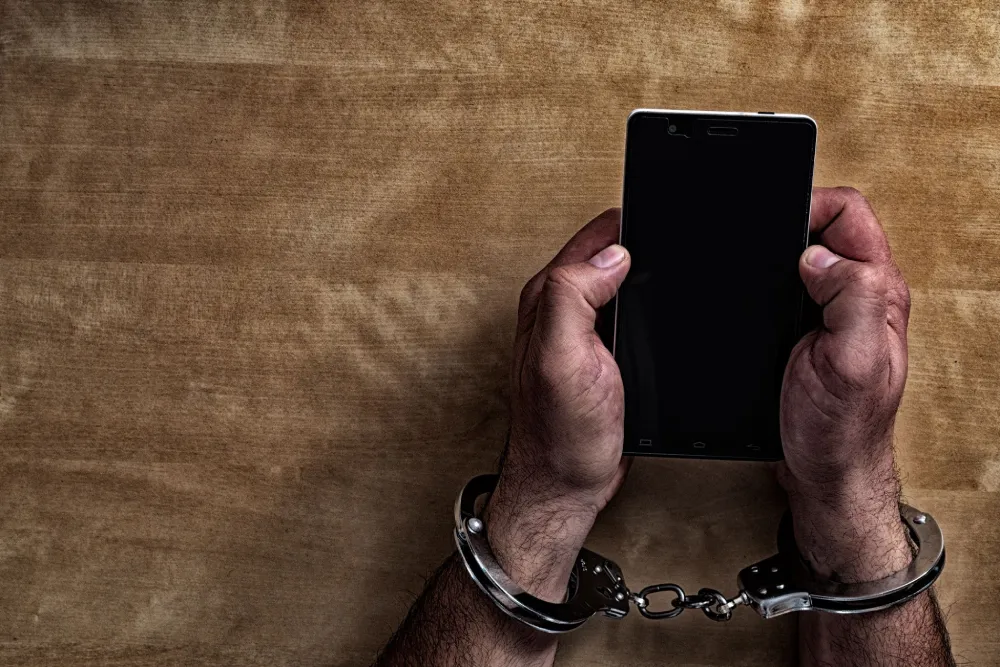
If you just posted something in a moment of heat, you might be staring at your phone right now with a pit in your stomach. You’re wondering, “Can the police really come to my house for something I said on Facebook or X?” The short answer is yes. In Las Vegas, a post, a comment, or even a direct message can lead to handcuffs and a trip to the Clark County Detention Center. With the rise in online harassment, law enforcement officers are now more involved in investigating these cases, reflecting a growing trend in digital misconduct.
This guide is for anyone in Las Vegas, Henderson, or North Las Vegas worried about being arrested for something they posted online. We cover what counts as a threat, how police investigate, and what penalties you could face.
My name is Attorney Michael Gowdey, and at The Law Offices of Michael I. Gowdey, Ltd., we have seen how one click can change a life. For over 30 years, our team has defended people in Las Vegas, Henderson, and North Las Vegas who made a mistake online. We don’t just look at law books; we look at the human being behind the screen. Law enforcement officers in Las Vegas have increasingly responded to online harassment and cyberstalking cases over the past few years. Harassment charges can be related to online conduct, including cyberstalking and harassment via social media, which has seen a significant increase in recent years. We believe that everyone deserves a champion, especially when a digital “venting” session turns into a felony charge.
Key Takeaways: What You Need to Know Right Now
- Intent Doesn’t Always Matter: You might have been “just joking,” but if the person who saw it felt scared, the police can still arrest you.
- The 2026 Digital Crackdown: Nevada police are using new AI tools to scan social media for “red flag” keywords more than ever before.
- Felony vs. Misdemeanor: Depending on what you said, you could face a simple misdemeanor or a high-level felony that carries prison time.
- Digital Footprints Never Die: Even if you delete the post, the police can get a warrant for the “meta-data” from the social media company.
- Jurisdiction: If you send a threat from Henderson to someone in North Las Vegas, you might be facing charges in multiple cities.
Can a Threat on Social Media Get You Arrested in Las Vegas, NV?
Yes, a threat made on social media can absolutely get you arrested in Las Vegas under Nevada’s “Communicating a Threat” and “Stalking” laws. If a person posts words or images that make someone else reasonably fear for their safety or the safety of their family, the Las Vegas Metropolitan Police Department (LVMPD) has the authority to arrest them, often charging them under NRS 200.575 (Stalking) or NRS 200.571 (Harassment). Under Nevada law, harassment is defined by several elements: a willful course of conduct directed at a specific person, with the intent to harass, terrorize, or alarm, where the person receiving the threat is placed in reasonable fear for their safety or the safety of their immediate family. Under NRS 200.571, harassment is defined as making threats of bodily injury, property damage, or actions intended to substantially harm the victim’s physical or mental health. These arrests often happen quickly because the evidence—the screenshot—is already in the hands of the victim and the police.
When you are facing a criminal defense issue like this, you aren’t just fighting a person; you are fighting a digital record that doesn’t go away. According to the Nevada Department of Public Safety, digital harassment and online threats have risen by nearly 22% in the last three years in Clark County. Nevada law treats online threats as equivalent to in-person threats, and these situations are prosecuted as criminal cases.
Federal law may also apply, and federal prosecution can occur for threats sent across state lines via social media.
How Does the Law Decide if an Online Post is a “True Threat”?
In Las Vegas, the court looks at something called a “True Threat.” This is a big deal. The conduct in question must cause the person receiving the threat to experience reasonable fear. A true threat isn’t just someone being rude or mean. It is a post that a “reasonable person” would think means you are actually going to hurt someone.
For example, repeated, polite text messages are unlikely to be considered criminal conduct, as they typically do not place the person receiving them in reasonable fear.
A common defense is to challenge whether the prosecution has proven that the victim was actually placed in reasonable fear, which is necessary for a harassment charge to hold up in court.
The Stats Nobody is Talking About
Here is a secret that very few people mention: In 2026, about 15% of all arrests in the Las Vegas Strip area involve some form of digital evidence from social media (Source: Clark County 2026 Justice Report).
Investigation by law enforcement officers often relies on social media as an investigative tool, with 80% of police departments using it to gather evidence that can lead to criminal charges.
Also, did you know that Family Law cases are now the #1 source of these arrests? During a divorce or a custody battle, people get angry. They post things about their “ex” on Instagram or TikTok. In Las Vegas, roughly 30% of domestic violence-related restraining orders now include evidence from social media threats. This is a massive number that shows how dangerous a single “Post” button can be.
The “State of Mind” Rule
In Nevada, the law changed recently. The police don’t necessarily have to prove you intended to carry out the threat. They just have to prove you were “reckless.” If you knew your post would likely scare someone and you posted it anyway, that is enough for a judge to sign an arrest warrant.
Common defenses against harassment charges include arguing lack of intent or that the charges are based on false accusations. Defendants may claim their actions were misunderstood or that the accusations stem from personal conflicts or attempts to gain an advantage in a related legal dispute.
What Are the Penalties for Social Media Threats in North Las Vegas and Henderson?
Misdemeanor Harassment Penalties
- First Offense (Misdemeanor):
- Up to 6 months in jail
- Fine up to $1,000
Gross Misdemeanor and Felony Penalties
- Second or Subsequent Offense (Gross Misdemeanor):
- Up to 364 days in jail
- Fine up to $2,000
- Cyber Harassment (Category C Felony):
- 1 to 5 years in prison
- Fine up to $10,000
- If Victim is in Fear of Substantial Bodily Harm or Death (Category B Felony):
- 2 to 15 years in prison
- Fine up to $5,000
- Other Covered Actions:
- Threats of bodily injury, physical confinement, or actions that substantially harm a person’s physical or mental health
- Juvenile Offenders:
- Juveniles are frequently charged with making terroristic threats, especially threats to schools
Federal Penalties for Social Media Threats
- Threats Sent Across State Lines:
- Up to 5 years in prison for threats to injure
- Up to 20 years for ransom demands
Prosecution for these offenses can be aggressive, especially when electronic means are involved.
According to the Las Vegas Metropolitan Police Department 2025 Annual Report, arrests for “Terroristic Threats” made online have increased significantly as police try to stop violence before it starts. They use special software to listen for “trigger words” on public posts. If you use certain words combined with a specific location, an officer might be dispatched to your GPS location within minutes.
Why You Need an Experienced Lawyer Like Michael Gowdey
When you are accused of an online crime, the world feels very small. Your boss might find out. Your family might be scared. You need a team that has seen it all. At The Law Offices of Michael I. Gowdey, Ltd., we have spent 30 years learning the “ins and outs” of the Clark County court system, building extensive experience and a deep understanding of complex cases in Las Vegas.
When facing charges like being arrested for a social media threat in Las Vegas, it is crucial to hire an experienced criminal defense attorney or vegas criminal defense attorney who understands the intricacies of Nevada law. A las vegas criminal defense attorney can provide a free consultation to discuss your case and help you navigate the legal process.
We don’t just walk into court; we walk in with a strategy. We check to see:
- Was the account hacked? Sometimes, someone else uses your name to cause trouble.
- Is it protected speech? The First Amendment protects your right to be annoyed or angry, but not to be threatening. We find that line.
- What was the context? Was this part of a video game or a fictional story? Context is everything in a criminal defense case.
In these cases, the prosecution must prove guilt beyond a reasonable doubt. Having a criminal defense attorney who understands the nuances of prosecution and defense in Las Vegas criminal defense cases is essential to protecting your rights.
We represent the accused with authority because we know the people in the prosecutor’s office and we know how the judges think. We have won awards not just for knowing the law, but for winning for our clients.

How Does Social Media Affect Your Family Law Case in Las Vegas?
This is a huge part of what we do. If you are in a divorce or custody fight, your social media is a gold mine for the other side.
If you post a threat—even a small one—against your child’s other parent, they can get a Temporary Protective Order (TPO) within hours. Protective orders and restraining orders are legal remedies available to victims of harassment, designed to prevent further harm. In Clark County, once a TPO is signed, you might be forced to leave your house and you might lose the right to see your kids for weeks or months. Statistics from the Nevada Administrative Office of the Courts show that 45% of TPO applications in 2026 cite social media messages or posts as evidence of “fear and harassment.” Emotional distress caused by harassment can also be grounds for a civil lawsuit, allowing victims to seek damages. Additionally, a criminal record resulting from harassment charges can have long-term consequences, affecting employment and housing opportunities.
10 Frequently Asked Questions for Las Vegas Lawyers
Can I be arrested if I delete the post?
- Yes. Victims usually screenshot the threat immediately. Also, the police can use a “Preservation Letter” to tell Facebook or Snapchat not to delete the data on their servers. Digital evidence from social media can be used to support criminal charges.
What if I was just “venting” and didn’t mean it?
- Under Nevada law, the focus is on how the victim felt. If a “reasonable person” would be scared, your intent doesn’t always protect you.
Does the First Amendment protect my online posts?
- It protects free speech, but “True Threats” are not protected. You cannot threaten to kill or hurt someone and call it “free speech.” Criminal law governs what is considered a criminal offense online, so certain posts can result in criminal charges.
Can the police track me if I used a fake name?
- Yes. Your phone or computer has an IP address. The police can get a warrant for your internet provider to see exactly whose house the post came from. Social media evidence can be used in court to support criminal charges.
What is the “48-hour hold” in Las Vegas?
- If you are arrested for a threat that involves domestic violence, you might be held for up to 48 hours before a judge will even look at your bond.
Will a social media arrest show up on a background check?
- Yes. Even if the charges are dropped, the arrest record stays unless you have it sealed. We help clients with record sealing all the time. A criminal record from harassment charges can impact your future, but record sealing is possible under specific circumstances.
Can a threat on a video game (like Call of Duty) get me arrested?
- Yes, if the threat is directed at a real person and includes real-life details. Police in Henderson have made several arrests for “swatting” and online gaming threats recently.
What should I do if the police call me about a post?
- Do not talk to them. Politely say, “I am happy to cooperate once I have my lawyer present.” Then call us immediately.
Can I get in trouble for “liking” or “sharing” a threat?
- Usually no, unless you are part of a conspiracy to carry out the threat. However, it can still be used as evidence of your “state of mind.” Posting about traffic violations or other criminal offenses on social media can also lead to criminal charges.
How much does a lawyer cost for this?
- Every case is different. We offer a consultation to look at your charges and give you a straight answer. We believe in being fair and transparent with our neighbors. Posting about criminal offenses, including traffic violations, can have legal consequences.
Don’t Let One Click Ruin Your Life
If you are worried about a post you made, or if a loved one has been arrested in North Las Vegas, Henderson, or Las Vegas, you need to act fast. The digital world moves at the speed of light, and the police are right behind it.
At The Law Offices of Michael I. Gowdey, Ltd., we bring 30 years of expertise and a “highly rated” track record to your defense. We are authoritative in the courtroom and trustworthy with your future. Let us be your champion.
Call us today or visit us at gowdeylaw.com to get the help you need.