
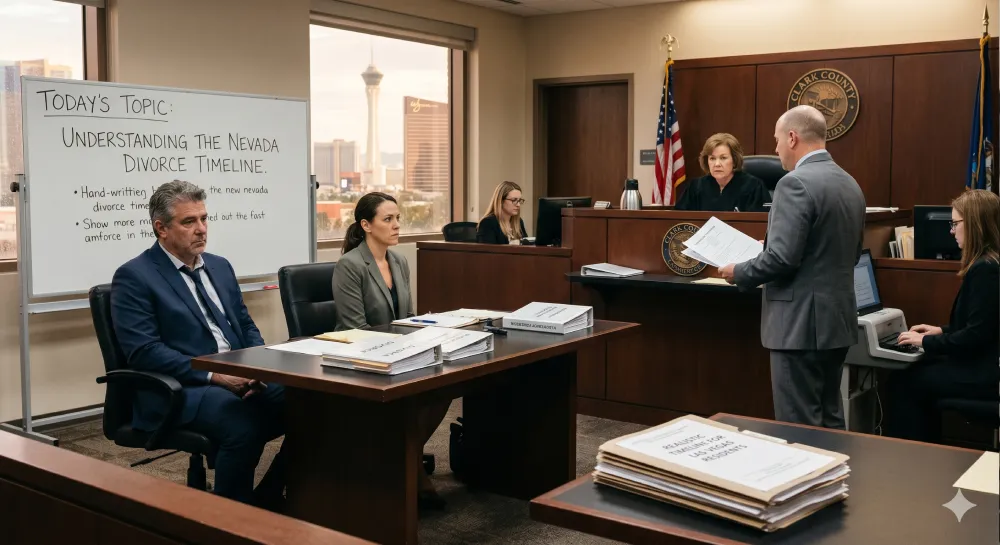
After 30 years of helping clients through family law matters in Clark County, I can tell you that the single biggest variable in divorce timeline is not the court — it’s the level of disagreement between the parties. Let me break down each scenario.
First Things First: Nevada’s Residency Requirement
Before any divorce can be filed in Nevada, at least one spouse must have been a resident of Nevada for a minimum of six weeks prior to filing. This is one of the shortest residency requirements in the nation, and it’s part of the reason Nevada became the divorce destination it is. Residency is established by physical presence with the intent to remain — staying in a Las Vegas hotel for six weeks without establishing Nevada domicile generally will not suffice.
For full details on this requirement, visit our Nevada divorce residency requirements page. If you’ve recently moved to Las Vegas, Henderson, or North Las Vegas and are considering divorce, the six-week clock starts the day you establish your Nevada residence.
Option 1: The Summary Divorce (Joint Petition)
Nevada offers the fastest possible divorce option — the joint petition for divorce, sometimes called a summary or simplified divorce — for couples who meet specific criteria:
- Both spouses agree that the marriage is irretrievably broken
- Neither spouse contests the divorce itself
- The couple has already reached agreement on all property, debt, and other issues
- There are no minor children from the marriage
- Neither spouse seeks alimony (or they’ve agreed to waive it)
When all of these conditions are met and both spouses cooperate fully, a Nevada divorce can be finalized in as few as 3 to 6 weeks after filing. The couple files jointly, the court reviews the paperwork, and a divorce decree is issued. In Clark County, the Eighth Judicial District Court processes joint petitions efficiently when documents are properly prepared.
This is as fast as divorce gets anywhere in the United States, and it’s a genuine option for couples in Las Vegas, Henderson, and North Las Vegas who have no children, limited assets, and full agreement on all issues.
Option 2: The Uncontested Divorce (One Party Files)
An uncontested divorce means one spouse files, the other is served, and they reach agreement on all issues — property division, debt, support, and if applicable, custody and child support. The key difference from a joint petition is that it starts with one party filing rather than both parties filing together. These are sometimes called “amicable divorces” even when one party initiates.
In Las Vegas, Henderson, and North Las Vegas, an uncontested divorce where the parties are fully in agreement typically takes 6 to 10 weeks from filing to a signed divorce decree. The timeline depends on how quickly the respondent is served, how promptly both parties return signed documents, and the current court caseload.
For a deeper comparison of the process on each path, visit our contested vs. uncontested divorce in Nevada page.
Option 3: The Contested Divorce
When spouses disagree on any significant issue — who keeps the house, how retirement accounts are divided, whether spousal support is owed, or how custody of children is arranged — the divorce becomes contested. This is where timelines extend significantly, and it’s important to have realistic expectations from the start.
A contested divorce in Clark County moves through several stages:
- Filing and Service (Weeks 1–4): One spouse files the complaint. The other must be formally served with divorce papers. In cooperative situations, this can happen quickly through a signed acceptance of service. In adversarial situations, service can be complicated.
- Response Period (Weeks 4–7): After service, the responding spouse has 21 days (or 30 days if served out of state) to file a formal response. The response sets out that spouse’s position on contested issues.
- Temporary Orders (if needed, Weeks 4–12): Either party can request temporary orders from the court governing who stays in the marital home, temporary custody and support, and other urgent matters while the case is pending. These hearings are typically scheduled within 30 to 60 days.
- Discovery (Months 2–6): Both parties exchange financial information — tax returns, bank statements, retirement account statements, business valuations, real estate appraisals. This phase can be prolonged if one party is uncooperative or if financial matters are complex.
- Mediation (Months 4–8): Clark County courts generally require divorcing couples to attempt mediation before proceeding to trial. Many contested divorces resolve at or after mediation, avoiding the expense and uncertainty of a trial.
- Trial (if needed, Months 8–18+): If mediation fails, the case is set for trial before a district court judge. Clark County District Court has significant caseloads, and trial dates may be set 6 to 12 months out from when the case is ready.
The realistic timeline for a fully contested divorce in Las Vegas that goes all the way to trial is 12 to 24 months. Some highly complex cases — particularly those involving business valuations, significant real estate holdings, or custody disputes with expert witnesses — can take longer.
| Here’s the honest truth: fighting over everything costs more and takes longer. That doesn’t mean you should give up what you’re entitled to. But it does mean that if agreement on some issues is possible, pursuing it strategically can save you months of your life and thousands of dollars. |
What Extends a Nevada Divorce Timeline?
Several factors regularly add time to divorce proceedings in Clark County:
- Minor children: Custody and child support disputes often require evaluation by a parenting coordinator, guardian ad litem, or custody evaluator — each of which adds months to the process.
- Business interests: If either spouse owns a business, the court may order a formal business valuation, which takes months and requires forensic accounting experts.
- Hidden assets: If one spouse is suspected of hiding assets — cash accounts, cryptocurrency, underreported business income — discovery becomes extensive and adversarial.
- Real estate: Disputes over whether to sell or retain the marital home, and at what value, often require appraisals and negotiation.
- One spouse’s non-cooperation: If your spouse refuses to respond to discovery requests, misses deadlines, or continually delays, the court can be asked to intervene — but this adds time.
- Relocation disputes: If one parent wants to move out of Clark County or out of Nevada with the children, this typically requires a separate hearing before a judge.
Nevada’s “No-Fault” Divorce: What It Means for Your Case
Nevada is a no-fault divorce state. Under NRS 125.010, incompatibility is sufficient grounds for divorce — you do not need to prove adultery, abandonment, or other fault-based grounds. This simplifies the divorce process significantly.
However, no-fault does not mean conduct is completely irrelevant. In some cases:
- A spouse’s financial misconduct (waste or dissipation of marital assets) can affect property division
- Domestic violence or substance abuse can affect custody arrangements
- Adultery, while not required as a ground for divorce, can sometimes factor into alimony determinations depending on circumstances
Property Division in Nevada: Community Property Rules
Nevada is a community property state. Under Nevada law, most assets and debts acquired during the marriage are owned equally by both spouses, and courts generally divide them 50/50 in a divorce. This includes:
- Income earned during the marriage
- Real estate purchased with marital funds
- Retirement account contributions made during the marriage
- Business interests built during the marriage
- Debts incurred during the marriage
Separate property — assets owned before marriage, inheritances, and gifts received by one spouse — generally remains with that spouse. However, the lines can blur when separate property becomes commingled with marital assets, which is why documenting your financial history carefully is important from the start.
Protecting Your Interests During the Divorce Process
Regardless of whether your divorce is simple or complex, here are the steps every spouse should take:
- Gather financial documentation now. Bank statements, tax returns, mortgage documents, retirement account statements, and business records. These become harder to access once adversarial proceedings begin.
- Understand your credit. Pull your credit report to identify all joint accounts and debts. Joint debts remain your liability even if a divorce decree assigns them to your spouse.
- Do not move assets. Moving or hiding marital assets after filing — or even after a serious separation — can be treated as dissipation of marital assets and will damage your credibility with the court.
- Be careful on social media. Posts, photos, and check-ins can be used as evidence in custody and support disputes.
- Consult with an attorney early. The decisions made at the beginning of a divorce — including what temporary orders to request and how to frame initial filings — shape the entire trajectory of the case.
Serving Las Vegas, Henderson, and North Las Vegas
Attorney Michael Gowdey and our family law team represent clients throughout Clark County in every type of divorce proceeding — from joint petition summaries to high-conflict contested trials. We appear regularly in Clark County District Court, the Eighth Judicial District Family Court, and mediation proceedings throughout the Las Vegas Valley.
If you’re considering divorce or have already been served with divorce papers, contact us today for a confidential consultation. Visit our Las Vegas divorce lawyer page or reach us at gowdeylaw.com/contact.
| Free Consultation — Law Offices of Michael I. Gowdey, Ltd. | Las Vegas, Henderson & North Las Vegas | gowdeylaw.com/contact |