
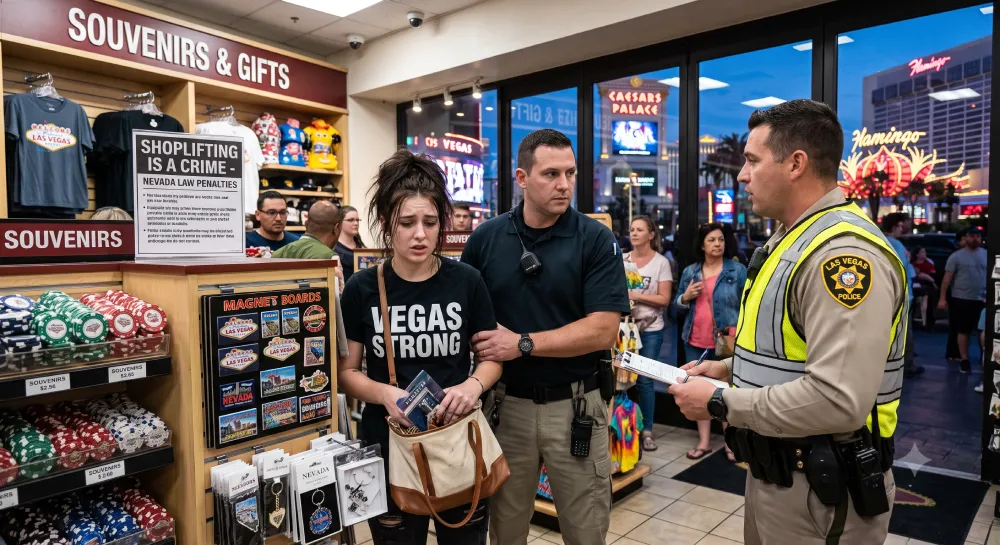
A lot of people walk out of a Las Vegas store thinking the worst part is the embarrassment. Then the civil demand letter arrives. Then the court date. Then the background check question. Here is the full picture — and what can actually be done about it.
It happens more often than you would think, and to people from every walk of life. A tourist visiting the Strip pockets something small on impulse and gets caught by loss prevention before they reach the door. A local grabs something at a Henderson big-box store and forgets they have it in their hand when the alarm goes off. A college student makes a terrible split-second decision in a North Las Vegas pharmacy.
Whatever happened in your situation, here is the reality: Nevada takes retail theft seriously. The state is currently experiencing a documented, multi-year rise in shoplifting cases, law enforcement is actively prioritizing these arrests, and the consequences — even for a first-time offense involving a relatively small amount — can follow a person for years if the case is not handled properly.
There is also a second punch that catches most people completely off guard: the civil demand letter. Even before your criminal case is resolved, a store’s attorneys can send you a formal demand for money under Nevada’s civil recovery laws. Many people panic and pay it without understanding what they are actually agreeing to or whether it affects their criminal case.
This page covers everything. The laws, the penalties, the civil recovery angle, the impact on your background check, and — most importantly — the very real options an experienced attorney can pursue to protect your record and your future.
For over 30 years, The Law Offices of Michael I. Gowdey, LTD has represented clients facing theft charges in Las Vegas, Henderson, North Las Vegas, and throughout Nevada. This is exactly the kind of case where having the right lawyer makes a measurable difference.
What Every Person Facing a Shoplifting Charge in Nevada Needs to Know
- Nevada does not have a specific “shoplifting” statute. It is charged as larceny under NRS 205.240 (petty) or NRS 205.220 (grand). The dividing line is $1,200.
- Las Vegas ranked 6th in the nation for retail crime impact in 2025, according to the National Retail Federation. This is not a city where these cases are brushed aside.
- LVMPD reported 5,072 shoplifting crimes in just the first nine months of 2025 — up from 4,562 in the same period the prior year. Arrests in 2025 were also up to 1,988 from 1,711 in 2024.
- North Las Vegas saw a 172% spike in shoplifting between 2023 and 2024 alone — totaling more than 3,600 reported cases over seven years.
- Organized retail crime in Nevada cost the state an estimated $466 million in stolen goods in 2021 and more than $85 million in lost tax revenue.
- A store can send you a civil demand letter for money — completely separate from the criminal case — even if you are never convicted.
- Two or more prior petit larceny convictions within 7 years can allow prosecutors to charge shoplifting as a felony burglary under NRS 205.060.
- A shoplifting conviction can be sealed from your record — but timing and the outcome of the case determine how long you have to wait.
- First-time offenders in Las Vegas Municipal Court may qualify for a “submittal” program that keeps a conviction off their record entirely — but only if handled correctly from the start.
5,072
Shoplifting crimes reported to LVMPD in first 9 months of 2025
172%
Shoplifting increase in North Las Vegas between 2023 and 2024
$466M
Stolen goods from organized retail crime in Nevada in 2021
#6
Las Vegas ranked 6th most affected U.S. city for retail crime (NRF 2025)
What Is the Difference Between Petty Theft and Grand Larceny in Nevada?
Nevada law does not use the word “shoplifting” anywhere in its criminal statutes. When you are arrested for taking something from a store, the charge will be filed as either petit larceny or grand larceny. The word that determines which one applies is a single dollar amount: $1,200.
That threshold — established under NRS 205.220 and NRS 205.240 — is the line between a misdemeanor and a felony. Everything below it is misdemeanor petit larceny. Everything at or above it is felony grand larceny. And the penalties on either side of that line are very, very different.
Under $1,200
Any amount below $1,200
Petit Larceny — Misdemeanor
$1,200 – $4,999
At or above $1,200
Grand Larceny — Category C Felony
$5,000 – $24,999
Category B
Grand Larceny — 1–7 Yrs Prison
$25,000+
Highest tier
Grand Larceny — 1–10 Yrs Prison
Here is the full penalty breakdown:
| Charge | Classification | Value Range | Prison / Jail | Fine |
|---|---|---|---|---|
| Petit Larceny (NRS 205.240) | Misdemeanor | Under $1,200 | Up to 6 months in county jail | Up to $1,000 + restitution |
| Grand Larceny (NRS 205.220) | Category C Felony | $1,200 – $4,999 | 1–5 years state prison | Up to $10,000 + restitution |
| Grand Larceny (NRS 205.222) | Category B Felony | $5,000 – $24,999 | 1–7 years state prison | Up to $15,000 + restitution |
| Grand Larceny (NRS 205.222) | Category B Felony | $25,000 or more | 1–10 years state prison | Up to $15,000 + restitution |
| Organized Retail Theft (NRS 205.0835) | Category B Felony | Aggregate $3,500+ | 1–10 years state prison | Up to $15,000 + restitution |
The $1,200 Threshold — and Why It Matters More Than You Think
The current Nevada felony threshold is $1,200. Governor Lombardo pushed to lower it to $750 during the 2025 legislative session, which would have automatically elevated many more shoplifting arrests to felony status. That effort did not pass — but it signals the political direction Nevada is heading. An experienced attorney knows how to challenge the valuation of merchandise and push back on how stores arrive at their claimed retail prices, which can be the difference between a misdemeanor and a felony charge.
When Shoplifting Can Be Charged as Burglary
Here is something almost nobody knows until it is directly in front of them. Under certain circumstances, shoplifting in Nevada can be charged not just as larceny but as burglary — a far more serious felony — under NRS 205.060.
Burglary charges in a shoplifting context become possible when you have been convicted of petit larceny two or more times within the immediately preceding 7 years, or if you have any felony conviction in your past. In those circumstances, the argument is that you entered the store “with intent to commit theft” — which is exactly what burglary covers. Burglary of a commercial establishment is a Category B felony carrying 1 to 10 years in prison.
This is one of the main reasons a second or third shoplifting charge is vastly more dangerous than a first. The record behind you can transform what looks like a minor offense into a felony prosecution.
What Happens If You Are Caught Shoplifting in Las Vegas for the First Time?
Let’s walk through what actually happens from the moment you are stopped to the day your case is resolved — because most people have no idea what to expect.
Step 1: Detention by Store Security
Under NRS 597.850, Nevada gives retailers and their employees the legal right to detain someone they believe has shoplifted — this is called the “shopkeeper’s privilege.” They can hold you on the premises in a reasonable manner for a reasonable period while they wait for police. They cannot physically assault you, hold you indefinitely, or conduct an intrusive search. If they exceed these limits, they lose their legal protection. An experienced attorney knows exactly where those limits are.
Step 2: Police Arrival and Possible Arrest
If the value of the merchandise is under $1,200, police may issue a citation rather than making a physical arrest — similar to a traffic ticket, but with a court date. If the value is over $1,200, or if there are aggravating circumstances (prior record, organized retail theft, property damage), you may be physically arrested and taken to the Clark County Detention Center for processing.
Step 3: The Civil Demand Letter
Shortly after the incident — sometimes before the criminal case even moves forward — you may receive a formal demand letter from the store’s attorneys seeking civil recovery. This is separate from the criminal case. More on this below in its own section.
Step 4: The Court Process
Petty larceny cases in Las Vegas typically go through Las Vegas Municipal Court. Grand larceny cases go to the Eighth Judicial District Court. Missing your court date is one of the worst things you can do — a warrant will be issued for your arrest. If you receive a citation, call an attorney before that date, not after.
The First-Offender “****Submittal****”** Option in Las Vegas**
Here is the part that gives first-time offenders real hope — but only if their case is handled correctly from the start. In Las Vegas Municipal Court, a common resolution for petit larceny first offenses is a “****submittal****”. This is not a conviction. Under this arrangement, you agree to complete certain conditions — typically including Petit Larceny School (an educational course about shoplifting consequences), community service, payment of restitution, and staying out of trouble for a period of time. If you complete all the requirements, the charge is dismissed entirely.
No conviction. No guilty plea on record. A much cleaner path to a record seal. This option is not available to everyone and is not automatic — it takes an attorney who knows how to present your case, negotiate the terms, and ensure you satisfy every condition correctly.
What a “****Submittal****”** Means in Plain Language**
Think of it as being on probation for the charge without actually pleading guilty. If you follow through on every condition, the charge disappears. If you miss a step, you can be convicted. Having an attorney manage this process is the difference between a clean outcome and a conviction that follows you for years.
What Are Nevada’s Civil Recovery Laws for Shoplifting?
This is the part that catches people most off guard, and it deserves its own section because it operates completely separately from the criminal justice system.
Under NRS 597.860, any adult who is caught shoplifting in Nevada is civilly liable — meaning the store has the right to sue them — for the retail value of the merchandise plus additional damages. For a minor, civil liability falls on the parents or legal guardians under NRS 597.870.
What Nevada’s Civil Recovery Laws Allow Retailers to Demand
- The retail value of the merchandise that was taken
- Additional damages of not less than $100 and not more than $250
- Court costs and reasonable attorney’s fees if a lawsuit is filed
- The action can be brought even if there is no criminal conviction — or even if charges were never filed
- Retailers can bring the action as a small claims case if the amount is within the small claims limit
In practice, many large retailers — national chains, department stores, and major Las Vegas shopping destinations — use third-party law firms that send out civil demand letters in bulk. These letters arrive demanding payment, often in the range of $150 to $500 or more, and they are designed to look very official and urgent.
Here is what you need to know about these letters:
- Paying the civil demand does not make your criminal case go away. These are two completely separate processes. The store’s lawyers and the DA’s office are different entities.
- Not paying does not automatically mean you will be sued. Many civil demand letters are never actually followed up with a lawsuit, because the cost of pursuing small-dollar claims in court is often not worth it for the retailer.
- Responding to the letter or making admissions in it can hurt your criminal case. Anything you write or say in response to a civil demand letter can potentially be used in your criminal proceedings. This is one of the most important reasons to contact an attorney before responding to any civil demand letter.
Do Not Respond to a Civil Demand Letter Without Talking to an Attorney First
The civil demand letter looks like it requires an immediate response. It often does not. More importantly, what you say — or what you pay — can create written evidence that makes your criminal case harder to defend. Contact The Law Offices of Michael I. Gowdey, LTD before you write a single word in response.
Does a Shoplifting Charge Show Up on a Background Check?
Yes. Until and unless your record is sealed, a shoplifting arrest and conviction will appear on a standard criminal background check in Nevada.
This matters enormously in Las Vegas specifically. The gaming industry — which employs hundreds of thousands of people across Clark County — conducts thorough background checks for all gaming-related positions. A theft conviction of any kind is one of the most disqualifying flags on a gaming license application. Healthcare employers, financial institutions, schools, and federal contractors are similarly careful about hiring people with theft convictions on their records.
There is also a more subtle issue that many people do not consider: the arrest itself can appear on a background check before the case is even resolved. This means that even while you are waiting for your court date, a background check can show the arrest. That is why having an attorney working toward a dismissal or a clean submittal — quickly and effectively — is so important for anyone whose employment depends on a clear record.
Can a Shoplifting Charge Be Expunged in Nevada?
Nevada does not have an expungement process for adults. What Nevada does have — and what serves a similar purpose — is record sealing. A sealed record is not expunged (physically destroyed), but it is hidden from public view, removed from standard background checks, and the person can legally say the arrest never happened when asked by employers, landlords, or licensing agencies.
For shoplifting / larceny charges, here are the sealing timelines under Nevada law:
Immediate
If the charge is completely dismissed — no conviction, no waiting period. Petition right away.
1 Year
After a petit larceny (misdemeanor) conviction — 1 year after the case fully closes, including probation.
5 Years
After a grand larceny (felony) conviction — 5 years after the case fully closes.
This is why the outcome of the original case matters so much for your long-term future. A dismissed case can be sealed immediately. A misdemeanor conviction requires a 1-year wait. A felony conviction locks you out for 5 years — and during those years, that record is visible to every employer, landlord, and licensing board running a background check.
The goal from the very beginning of a shoplifting case should be to achieve the outcome that creates the cleanest possible path to a sealed record. That requires a lawyer who is thinking not just about today’s court date, but about the record that follows you afterward.
The Legal Fresh Start — What a Sealed Record Actually Does
Once a Nevada record is sealed, the proceedings are legally treated as though they never occurred. Under Nevada law, you can answer “No” when a job application, housing application, college application, or professional license asks whether you have ever been arrested or convicted. This is not bending the truth — it is a genuine legal right that your attorney can help you earn. Learn more about record sealing at gowdeylaw.com/.
What Legal Defenses Can Actually Beat a Shoplifting Charge in Nevada?
People assume that if a store’s cameras caught them, the case is already over. It is not. The prosecution must prove beyond a reasonable doubt that you intentionally stole the merchandise. Intent is the legal linchpin of every larceny case in Nevada — and it is also the most commonly exploited weakness in these prosecutions.
Lack of Intent
This is the most powerful and frequently successful defense in shoplifting cases. If you walked out of a store without paying for something but did not intend to steal it — you were distracted, you forgot it was in your hand or your basket, you genuinely believed it was paid for — that is not larceny. Courts have dismissed shoplifting cases based on exactly this argument. The question is whether the evidence truly shows intentional theft or something that looks like it but is not.
Mistaken Identity
Loss prevention officers are human beings who sometimes get things wrong. If you were misidentified as the person who took the merchandise — especially in a crowded store, a busy casino shop, or a high-volume retail environment — that is a genuine defense. Surveillance footage is not infallible. Angles are incomplete. People get misidentified. An attorney who reviews the actual footage critically can often find problems the prosecution never expected.
Illegal Detention or Search
Store employees have the right to detain you — but only in a reasonable manner, for a reasonable time, with reasonable grounds. If the detention exceeded those limits, if police conducted an unlawful search, or if you were not actually on the premises when the alleged theft occurred, these procedural violations can be the basis for suppressing evidence or dismissing the charge. Under the Fourth Amendment, evidence obtained through an unlawful search cannot be used against you.
Challenging the Valuation
The $1,200 threshold between a misdemeanor and a felony in Nevada is not always as clear-cut as the store’s loss prevention report makes it seem. Stores sometimes price merchandise at full retail value for valuation purposes, when the actual replacement value — which is the legally appropriate measure — is significantly lower. Challenging the valuation of stolen merchandise can be the specific legal move that keeps a case in misdemeanor territory rather than escalating it to a felony.
Insufficient Evidence
If the prosecution’s evidence comes down to a store employee’s testimony alone — with no video, no tagged merchandise recovered from your possession, no corroborating witnesses — that is a thin case that may not survive a challenge at trial or even in pretrial negotiations. Prosecutors know what a weak case looks like and will often negotiate when an experienced defense attorney points out exactly how thin the evidence actually is.
Why Do People Facing Shoplifting Charges in Las Vegas, Henderson, and North Las Vegas Turn to Michael I. Gowdey?
A shoplifting charge might feel like a small thing in the grand scheme of life. But the consequences — a permanent criminal record, a lost job opportunity, a denied housing application, a revoked gaming card — are not small. They are real, and they can compound for years.
The enforcement environment in Southern Nevada right now makes this especially urgent. LVMPD has explicitly stated they are ramping up arrest activity to match the rise in shoplifting reports. Henderson Police dedicated specific resources to Black Friday enforcement operations in 2025, resulting in 19 arrests and 11 citations in a single day. And the National Retail Federation ranked Las Vegas 6th nationally for retail crime impact in 2025. These are not the conditions under which shoplifting cases get ignored or quietly dropped.
What The Law Offices of Michael I. Gowdey, LTD brings to a shoplifting case is precisely what first-time offenders need most: over 30 years of experience in Clark County courts, a deep understanding of the submittal and diversion options available to first-time defendants, the ability to challenge how the merchandise is valued, and a commitment to pursuing the outcome that best protects each client’s future — not just their next court date.
That also means, if your case involves related issues — like a gaming card that is at risk, or a family court matter that could be affected — the firm’s comprehensive practice has you covered. Everything under one roof. No bouncing between attorneys. No gaps in your defense.
MG
Attorney Michael I. Gowdey — Over 30 Years Defending Nevada Clients
From the moment you are stopped by loss prevention to the day your record is sealed — this firm is with you for every step. Michael I. Gowdey has built a career on the belief that every client deserves clarity, compassion, and a champion in their corner. Multiple awards for legal excellence in Nevada. Decades of experience in Las Vegas, Henderson, North Las Vegas, and across the state. A genuine commitment to fighting for outcomes that protect people’s futures, not just outcomes that clear the docket.
Schedule Your Free Consultation →
Top 10 Questions People Ask Shoplifting Defense Lawyers in Nevada
1. Is shoplifting a misdemeanor or felony in Nevada?
It depends on the value of what was taken. Under NRS 205.240, taking merchandise worth less than $1,200 is misdemeanor petit larceny — punishable by up to 6 months in county jail and a fine up to $1,000. Taking $1,200 or more triggers NRS 205.220, which is felony grand larceny — carrying 1 to 5 years in state prison at the lowest tier, scaling upward based on the total value. A prior criminal record can also push what might have been a misdemeanor into felony burglary territory.
2. What is a civil demand letter for shoplifting and do I have to pay it?
A civil demand letter is a written demand from a retailer’s attorneys seeking monetary compensation under Nevada’s civil recovery statutes (NRS 597.860). The store can demand the retail value of the merchandise plus damages between $100 and $250, plus court costs and attorney’s fees if they file suit. Importantly, this letter comes separately from the criminal case and a store can send it even if you are never convicted. You are not legally required to pay it without a court order, and responding to it without an attorney can create written evidence that hurts your criminal defense. Always talk to a lawyer before responding.
3. Will a shoplifting arrest show up on a background check in Nevada?
Yes — both the arrest and any resulting conviction will appear on a standard background check until your record is sealed. The arrest itself can show up even before your case is resolved. Once a conviction is on your record and the appropriate waiting period has passed — 1 year for petit larceny, 5 years for grand larceny — you can petition to have the record sealed. A dismissal can be sealed immediately. After sealing, you can legally answer “no” when employers ask about your criminal history.
4.What happens at my first court appearance for a shoplifting charge in Las Vegas?
For a petit larceny citation, your first court appearance will be at Las Vegas Municipal Court. You will be asked to enter a plea. If you have an attorney, they can negotiate for a submittal arrangement — where you agree to complete certain conditions (Petit Larceny School, community service, restitution) in exchange for a dismissal upon completion. Going in without a lawyer and pleading guilty or no contest at that first appearance often locks you into a conviction and a waiting period before record sealing — when a better outcome may have been available. Having counsel before that first date is critical.
5. Can a shoplifting charge be dismissed in Nevada?
Yes — dismissal is a real and achievable outcome, particularly for first-time offenders. The most common paths to dismissal include successfully completing a submittal program in Las Vegas Municipal Court, demonstrating lack of intent, challenging the legality of the search or detention, or establishing that the evidence is insufficient to prove theft beyond a reasonable doubt. An experienced attorney evaluates which strategy is most viable based on the specific facts of your case — the store, the surveillance footage, your history, and the nature of the merchandise involved.
6. I am not a Nevada resident — I was visiting Las Vegas when I was arrested for shoplifting. What happens now?
Out-of-state and international visitors make up a significant portion of shoplifting arrests in Las Vegas, given the volume of tourism. A Nevada shoplifting charge does not simply disappear because you go home. Missing your Nevada court date results in a bench warrant for your arrest — enforceable if you ever return to Nevada or, in some cases, through other interstate mechanisms. An attorney licensed in Nevada can often appear on your behalf without you needing to return to Las Vegas for every proceeding, which is one of the most practical benefits of retaining local counsel quickly.
7. Can a shoplifting conviction affect my gaming license or gaming work card in Las Vegas?
Yes, significantly. The Nevada Gaming Control Board conducts thorough background checks for all gaming license applicants. A theft conviction — even a misdemeanor petit larceny — is one of the most common grounds for denial or revocation of a gaming work card. This affects casino employees, gaming operators, and anyone in a licensed gaming-adjacent role. Given that the gaming industry employs a substantial portion of Clark County’s workforce, a shoplifting conviction can directly threaten your livelihood. This is one of the most powerful reasons to fight these charges aggressively from the very beginning.
8. What is “****organized retail theft****”** in Nevada and how is it different from regular shoplifting?**
Organized retail theft under NRS 205.08345 and NRS 205.0835 involves a coordinated scheme — typically three or more people working together — to steal merchandise from retail establishments. Charges are based on the aggregate value of all stolen goods across multiple incidents. When that total reaches $3,500 or more, organized retail theft is a Category B felony carrying up to 10 years in state prison. LVMPD has created dedicated investigative units targeting organized retail crime, and federal prosecutors have also increased involvement. Being linked to an organized theft ring — even if your individual role was minor — dramatically escalates the legal consequences.
9. What is Petit Larceny School in Las Vegas and is it worth doing?
Petit Larceny School is a short educational course about the consequences of shoplifting and available community resources. It is required as one of the conditions of the submittal program in Las Vegas Municipal Court — a first-offense diversion pathway that ends in a charge dismissal if all conditions are met. Completing Petit Larceny School as part of a submittal is absolutely worth it if it results in a dismissal rather than a conviction. The distinction matters enormously for your employment prospects, your background check, and your path to a clean record seal. Your attorney can advise you whether you qualify and guide you through the process.
10. How does a Nevada shoplifting conviction affect immigration status?
A shoplifting conviction — even a misdemeanor — can have serious immigration consequences for non-U.S. citizens. Theft-related offenses are considered crimes of moral turpitude under federal immigration law, which can make a person inadmissible, deportable, or ineligible for certain immigration benefits including green card applications, naturalization, and visa renewals. The stakes are especially high for people in DACA status or on work visas. If you are not a U.S. citizen and you are facing a theft charge of any kind, it is critical that you retain an attorney before entering any plea — even if the charge seems minor. A plea that looks routine in criminal court can have permanent immigration consequences.
The Law Offices of Michael I. Gowdey, LTD
Justice with Integrity | Representation with Heart
Serving Las Vegas · Henderson · North Las Vegas · All of Nevada — gowdeylaw.com/
This page is for general informational purposes only and does not constitute legal advice. Reading this page does not create an attorney-client relationship. Every case is unique — contact our office directly to discuss the specifics of your situation.